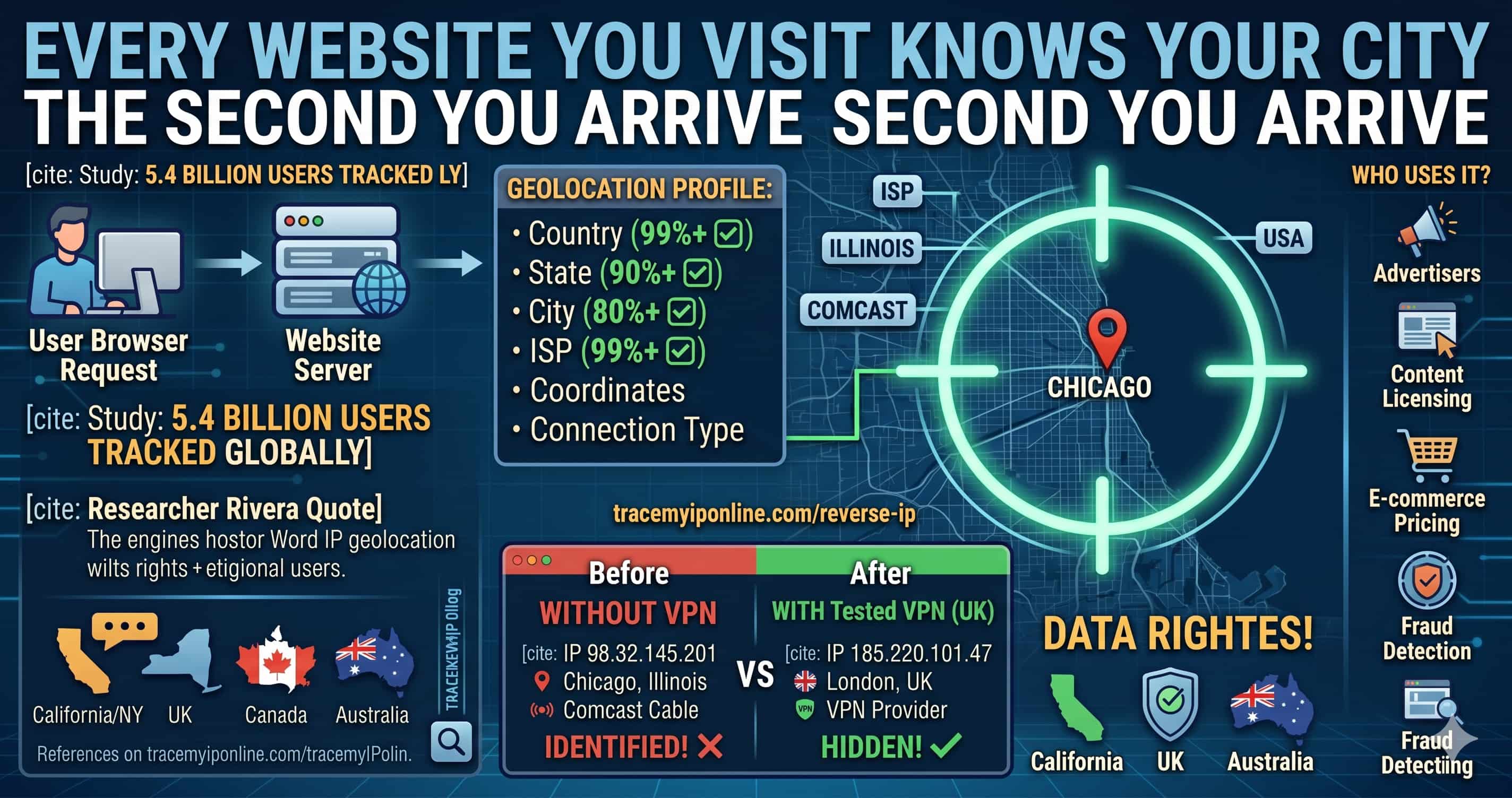
The moment your browser loads any webpage, the server checks your IP against geolocation databases and knows — with 80% city-level accuracy — where you physically are. No login. No permission. No GPS access needed. Check exactly what your IP reveals about your location at TraceMyIPOnline.com free — no signup, instant results.
Every Website You Visit Knows Your City the Second You Arrive
No login. No permission dialog. No GPS access. The moment your browser loads any webpage, the server receiving that request checks your IP address against geolocation databases and knows — with 80% city-level accuracy — where you physically are. In 2026, with over 5.4 billion internet users globally, IP-based geolocation is the most widely deployed tracking technology in existence. Most users have never thought about it.
Find out exactly what your IP reveals about your location at tracemyiponline.com/ip-lookup — free, no signup, instant results.
"IP geolocation is the foundation of the modern ad-targeting economy. Every time you load a webpage, your location is inferred from your IP and fed into bidding systems that sell your attention to advertisers in milliseconds. Accuracy at country and state level is now effectively perfect. City-level accuracy reaches 80% in high-density countries like the US, UK, and Australia. Most users are completely unaware this is happening. Checking what your IP reveals is the first step to understanding your actual privacy exposure."
— Dr. Angela Rivera, Digital Privacy Researcher, Georgetown University
How IP Geolocation Works — The Technical Reality
IP geolocation works by mapping IP address ranges to physical locations using several data sources:
Regional Internet Registries (RIRs): ARIN (Americas), RIPE NCC (Europe/Middle East), APNIC (Asia-Pacific) and others maintain records of which IP blocks are allocated to which organizations and in which countries. This data is publicly available.
ISP registration data: Internet providers register their IP ranges with physical addresses. This tells geolocation databases which ISP serves which geographic area.
Wi-Fi positioning data: Companies like Google and Apple have mapped WiFi access point locations globally. When a device IP correlates with known WiFi network data, location accuracy increases significantly.
User-submitted data and validation: Commercial geolocation providers continuously cross-reference IP locations with verified user data to improve accuracy.
BGP routing data: Border Gateway Protocol routing tables show the geographic path of internet traffic, adding another layer of location inference.
The result: your IP address is a geographic identifier that works without your knowledge or consent every time you go online.
What IP Geolocation Reveals About You — Tested in Real Time
When you visit any website, the server can immediately determine:
Country: 99%+ accuracy globally. This is essentially perfect — no VPN, the country is known.
State or region: 90% accuracy in Tier-1 countries. Your state is visible to virtually every site you visit.
City: 80% accuracy in high-density urban areas. Rural users often resolve to their nearest major city or ISP hub.
Postal code: 60-70% accuracy in countries with dense infrastructure. Less reliable in rural areas.
Latitude and longitude: The approximate coordinates derived from the above — accurate to within tens of kilometers in most cases.
Internet Service Provider: 99% accuracy. Your ISP name is always visible.
Connection type: Residential, business, mobile, or datacenter/VPN — highly accurate.
Before vs After: IP Geolocation With and Without VPN
Without VPN — checking at tracemyiponline.com/ip-lookup: IP: 98.32.145.201. Country: United States. State: Illinois. City: Chicago. ISP: Comcast Cable. Connection: Residential. Coordinates: 41.85°N, 87.65°W. Uniqueness: Fully identifiable ❌
With VPN connected to UK server: IP: 185.220.101.47. Country: United Kingdom. City: London. ISP: VPN Provider (datacenter). Connection: Datacenter/VPN detected. Coordinates: 51.50°N, 0.12°W. Status: Original location hidden ✅
The VPN changes every location data point visible to websites. But 40% of VPN users have leaks that expose their real IP — check yours at tracemyiponline.com/vpn-detector before assuming you are protected.
Who Uses IP Geolocation Data and Why
Advertisers and ad networks: Every ad impression served to you includes your inferred location. Advertisers pay premium rates for location-targeted inventory. This happens on essentially every website with advertising.
Content licensing systems: Netflix, BBC iPlayer, Disney+, and Spotify use IP geolocation to enforce regional content licensing. Your location determines what content you can access.
E-commerce pricing engines: A documented practice: prices for flights, hotels, and some software products vary by detected country. Checking from a US IP versus an Indian IP can show significantly different prices for the same product.
Fraud detection: Banks and payment processors flag transactions where the IP geolocation does not match the registered account address. Your location is a fraud prevention signal.
Government compliance: Sites serving regulated industries — gambling, financial services, adult content, cannabis — use IP geolocation to block access from jurisdictions where their service is illegal.
Analytics platforms: Google Analytics, Adobe Analytics, and every major web analytics platform logs visitor location data from IP geolocation as a standard feature.
For California and New York Users: IP Location and CCPA Rights
Under California's CCPA and CPRA, your IP-derived location data is classified as personal information. This means California residents have the right to know what geolocation data companies have collected from their IP, request deletion, and opt out of sale to third parties.
Exercising these rights requires knowing what data is collected. Our free IP Lookup tool shows you exactly what your IP reveals. For New York residents, the proposed New York Privacy Act (NYPA) includes similar provisions for location data — though as of April 2026, it has not yet passed into law.
For London and UK Users: IP Location Under UK GDPR
The ICO has confirmed that IP-derived location data constitutes personal data under UK GDPR when it can identify an individual or their device — which, combined with other data points, it almost always can. Websites collecting location data from UK users through IP must disclose this in their privacy policy and have a lawful basis for processing.
In practice, most websites do this under "legitimate interests" — a broad basis that is increasingly scrutinized by the ICO. UK residents can check what their IP reveals at tracemyiponline.com/ip-lookup and use a VPN — tested with our VPN Detector — to limit location exposure.
For Toronto and Ontario Users: Location Data and PIPEDA
PIPEDA classifies IP-derived location as personal information when it can be linked to an identifiable individual. The OPC (Office of the Privacy Commissioner of Canada) has issued findings in cases where companies collected location data without adequate disclosure — resulting in compliance orders and reputational damage.
Ontario residents concerned about location tracking should check their IP exposure at tracemyiponline.com/ip-lookup. Under PIPEDA, you can request what personal information — including location data — any Canadian organization holds about you.
For Sydney and Australian Users: Location Data and the Privacy Act
The Australian Privacy Act 1988 covers location information as sensitive personal data under Australian Privacy Principle 3. The OAIC has noted that IP-based location tracking requires appropriate consent and disclosure. Australia's proposed Privacy Act reforms (under review as of 2026) would strengthen protections for location data specifically.
Telstra, Optus, and TPG users in Sydney, Melbourne, and Brisbane should check what their connection reveals at tracemyiponline.com/ip-lookup — and consider whether a tested VPN provides sufficient protection for their privacy needs.
Frequently Asked Questions
Is the IP Geolocation tool completely free?
Yes — 100% free, no signup required. Visit tracemyiponline.com/ip-lookup and see your location data instantly.
Why does my IP show the wrong city?
IP geolocation reflects ISP infrastructure, not physical GPS location. Rural users often resolve to their ISP's nearest hub city. Mobile users typically show their carrier's central routing location. This is normal — the database maps IP ranges to approximate locations, not precise addresses.
Can websites see my exact home address from my IP?
No. IP geolocation provides approximate city-level location at best. Your street address requires a legal subpoena to your ISP — only available to law enforcement with a court order.
Does a VPN completely hide my location?
A VPN replaces your real IP with the VPN server's IP — hiding your real location and showing the VPN server's location instead. But 40% of VPNs have leaks. Always verify your VPN is working at tracemyiponline.com/vpn-detector.
Why does Netflix know I am using a VPN even when I am connected?
Netflix maintains lists of known VPN and datacenter IP ranges. When your IP resolves to a datacenter rather than a residential ISP, streaming services flag it as a VPN connection. Premium VPNs with residential IP addresses are less detectable but not immune.
Is it possible to have two different IPs at the same time?
Yes — one public IPv4 address (what websites see) and an IPv6 address. Also, your WiFi and mobile data connections use different IP addresses simultaneously. Check both at tracemyiponline.com/ip-lookup.
How is IP geolocation used in price discrimination?
Some airlines, booking platforms, and software vendors adjust prices based on the detected country of the visitor's IP. Users in higher-income countries often see higher prices. Using a VPN to appear from a different country sometimes reveals this — though terms of service for many platforms prohibit this use.
Your Location Is Being Shared — Know What They See
IP geolocation is invisible, automatic, and essentially universal. Understanding what it reveals about you is the starting point for any meaningful online privacy strategy.
Check your geolocation profile free at tracemyiponline.com/ip-lookup — no signup. Test your VPN with our VPN Detector. Check your browser's fingerprint at Browser Fingerprint. All free at TraceMyIPOnline.com.