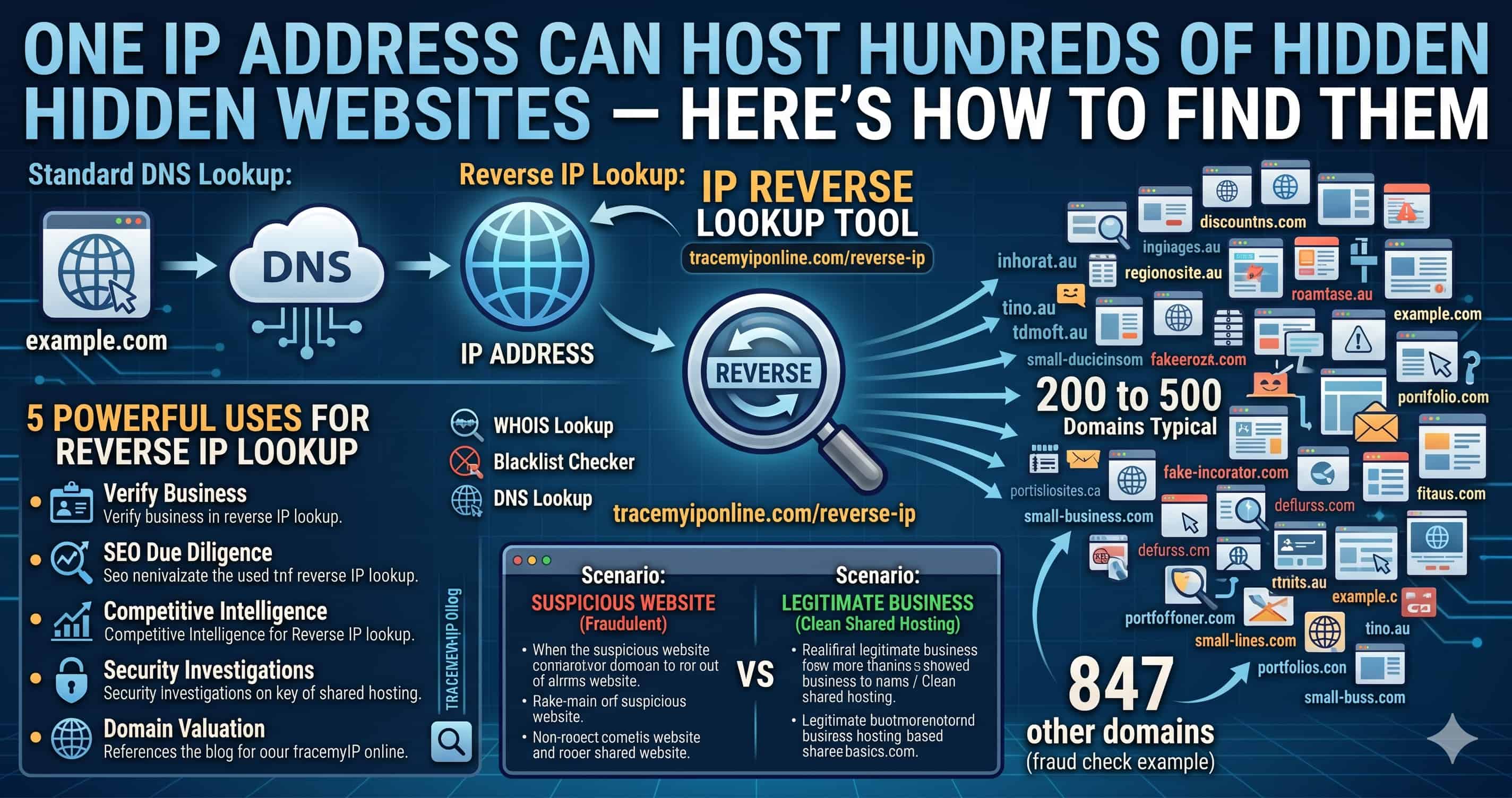
On shared hosting, a single IP address routinely hosts 200 to 500 different domains — and the reputation of every one affects yours. A spam operation sharing your IP can silently damage your email deliverability and SEO standing. Run a free Reverse IP Lookup at TraceMyIPOnline.com to see exactly who your IP neighbors are — no signup, results in seconds.
One IP Address Can Host Hundreds of Hidden Websites — Here's How to Find Them
On shared hosting — where the vast majority of small business websites live — a single IP address routinely hosts 200 to 500 different domains. Some hosting companies pack even more. This fact has significant implications for SEO, security, and due diligence: the reputation of every website on that shared IP affects yours. And the only way to see who your IP neighbors are is a Reverse IP lookup.
Check any IP address's hosted domains instantly at tracemyiponline.com/reverse-ip — free, no signup, results in seconds.
"Reverse IP lookup is standard practice in both competitive intelligence and security investigations. When we assess a website's trustworthiness, one of the first checks is what other domains share its IP. A legitimate business website sitting on an IP that also hosts 300 spam domains has a serious credibility and deliverability problem — even if the business itself has done nothing wrong. This is a genuine risk that most small business owners have never heard of."
— Claire Hoffman, Digital Security Consultant, NetSafe Advisory Group
What Is Reverse IP Lookup and How Does It Work?
A standard DNS lookup takes a domain name and returns its IP address. Reverse IP lookup does the opposite: it takes an IP address and returns all domain names hosted on that IP.
How it works technically: web servers are configured with "virtual hosting" — a single server with one IP address serves multiple websites by reading the domain name from the HTTP request header and routing to the right site. Since all these domains share the IP, a reverse lookup can identify them all.
The data comes from DNS records, certificate transparency logs, web crawl data, and passive DNS databases — all publicly available sources. Nothing about performing a reverse IP lookup is private or sensitive.
Before vs After: What Reverse IP Reveals About a Suspicious Website
Scenario — e-commerce site claiming to be an established US retailer:
WHOIS check: Domain registered 3 weeks ago. Reverse IP lookup on their server IP reveals: 847 other domains on the same IP. Domains include: discount-pills-online.com, fake-invoice-generator.net, lottery-winner-2026.com. Result: Fraudulent operation — IP shared with known scam infrastructure ❌
Contrast — legitimate mid-size business on shared hosting:
Reverse IP lookup: 34 co-hosted domains. Domains are small local businesses, personal portfolios, and regional companies. No blacklisted or suspicious domains. Result: Clean shared hosting environment ✅
This check takes 10 seconds at tracemyiponline.com/reverse-ip. Combine with our WHOIS Lookup for complete website verification.
5 Practical Uses for Reverse IP Lookup in 2026
1. Verify a business before payment: Check the IP of an unfamiliar e-commerce site. If it shares an IP with known spam or scam domains, walk away.
2. SEO due diligence before shared hosting: Before signing with a hosting company, reverse-lookup their server IPs. If they host spammy or penalized domains, sharing their IP could harm your search rankings.
3. Competitive intelligence: Find domains a competitor company operates on the same server — revealing sister brands, test sites, and acquisitions they have not publicized.
4. Security investigations: If you receive suspicious traffic from an IP, check what other domains are hosted there to understand the context of the source.
5. Domain valuation: Before purchasing a domain, check the history of its current IP. Previous bad-neighborhood associations can affect both SEO value and email deliverability.
For California and New York Businesses: Shared Hosting and SEO Risk
Google has confirmed in multiple public statements that it evaluates websites individually rather than penalizing by shared IP — but that statement comes with important caveats. If your IP neighbors are blacklisted for spam or malware, your outbound emails may be affected, your IP may appear on threat intelligence feeds, and security-conscious visitors may see browser warnings related to the shared server.
California businesses competing in high-value search categories — legal services, real estate, healthcare, finance — cannot afford IP-level reputational risks. New York's dense competitive environment makes clean hosting infrastructure particularly important. Check your hosting IP at tracemyiponline.com/reverse-ip and verify your IP reputation with our Blacklist Checker.
For London and UK Businesses: Reverse IP and GDPR Data Flows
UK businesses on shared hosting should be aware that data processed by their website may pass through a server also handling data for other organizations. Under UK GDPR, understanding your data processing chain — including shared infrastructure — is part of your compliance obligations, particularly for Article 30 Record of Processing Activities documentation.
Reverse IP lookup helps UK businesses in London, Manchester, and Birmingham understand their hosting environment. If your server is shared with organizations handling sensitive data in ways that conflict with UK GDPR standards, this could create compliance complexity. Check your IP environment free at tracemyiponline.com/reverse-ip.
For Toronto and Ontario Businesses: IP Reputation in Canadian Markets
Canadian email deliverability standards are among the strictest globally due to CASL. A business in Toronto sending customer emails from an IP shared with spam domains will see rejection rates climb regardless of CASL compliance — because email servers check IP reputation before content.
The fix is straightforward: check your current IP environment using our Reverse IP tool, verify IP reputation at our Blacklist Checker, and consider dedicated IP hosting if you share space with problematic neighbors.
For Sydney and Australian Businesses: Shared Hosting Risks Down Under
Australian businesses on budget shared hosting face the same IP-sharing risks as anywhere else — but with an added layer. Many Australian SMBs use hosting companies that place their servers in Singapore or the US, meaning their IP neighbors are from entirely different regulatory environments.
The ACCC and OAIC both recommend businesses understand their data processing infrastructure. Reverse IP lookup gives Sydney and Melbourne businesses immediate visibility into who shares their server. Check at tracemyiponline.com/reverse-ip — free, no account needed.
Reverse IP vs WHOIS vs DNS Lookup — Which to Use When
Use Reverse IP when: You want to find all domains on a specific server IP. You want to check a business's hosting neighbors. You are investigating a suspicious IP address.
Use WHOIS when: You want to know who registered a specific domain. You want to check domain age and expiry. You are verifying a business's online history. Try our free WHOIS Lookup.
Use DNS Lookup when: You want to see a domain's technical records. You are verifying email authentication (SPF, DKIM, DMARC). You are troubleshooting DNS propagation. Try our free DNS Lookup.
For complete website investigation, use all three in combination.
Frequently Asked Questions
Is the Reverse IP Lookup tool completely free?
Yes — 100% free with no signup, no account, and no usage limits. Visit tracemyiponline.com/reverse-ip and get results instantly.
Is it legal to look up what domains share an IP?
Completely legal. This information comes from public DNS records and web crawl data. Reverse IP lookup is a standard tool used by security researchers, SEO professionals, and fraud investigators worldwide.
Why does my website's IP show hundreds of other domains?
You are on shared hosting — the standard arrangement for small and medium websites. Your hosting provider puts many websites on one server to reduce costs. This is normal and not inherently a problem, though the quality of your IP neighbors matters.
Does sharing an IP hurt my Google rankings?
Google says it evaluates sites individually, not by IP. But if your IP is blacklisted due to neighbor activity, your email deliverability suffers and your IP may appear on threat intelligence feeds used by browsers and security tools — which can indirectly affect trust signals.
How many domains on one IP is too many?
There is no hard limit, but over 500 domains on one IP generally indicates a very low-cost hosting environment with minimal quality control over neighbors. For business-critical websites, dedicated or semi-dedicated IP addresses are worth considering.
Can I use Reverse IP to find competitor websites?
Yes. If a competitor uses the same hosting company, their other domains may share an IP. This is legitimate competitive intelligence and completely legal — the information comes from public data.
What is the difference between a dedicated IP and shared IP?
A dedicated IP is assigned exclusively to one domain — only your website uses it. A shared IP serves many domains. Dedicated IPs cost extra but offer cleaner reputation, better email deliverability, and isolation from neighbor problems.
Your IP's Neighbors Matter More Than You Think
Most website owners never check what sits on their IP. They pay for hosting, point their domain, and assume the rest is fine. Sometimes it is. Sometimes they are sharing server space with spam operations, gambling sites, or phishing infrastructure they have no idea about — and their email deliverability and IP reputation quietly suffer for it.
A 10-second Reverse IP check tells you. Start at tracemyiponline.com/reverse-ip — free, no signup. Then check your IP reputation and verify your domain with our WHOIS Lookup. All free at TraceMyIPOnline.com.