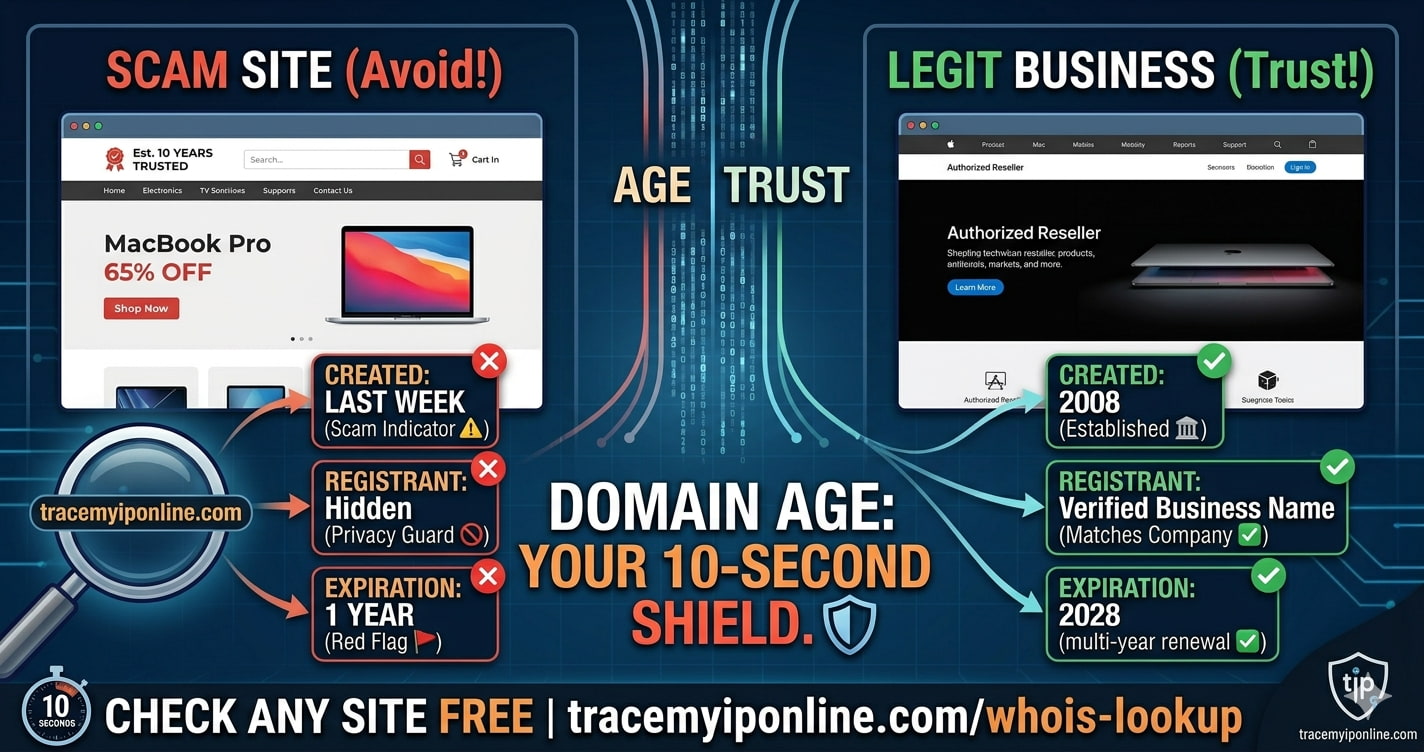
The FBI 2025 Internet Crime Report recorded $12.5 billion in US online fraud losses — and 95% of those fraudulent sites were under 30 days old when first reported. Domain age is the single strongest fraud indicator available, and it takes 10 seconds to check. Look up any website free at TraceMyIPOnline.com WHOIS tool — no signup, no account required.
95% of Scam Websites Are Under 30 Days Old — Here's How to Check Any Site in 10 Seconds
The FBI's 2025 Internet Crime Report documented $12.5 billion in US online fraud losses — and buried in the detail is a pattern that repeats across virtually every case: the fraudulent website was newly registered. Research by the APWG (Anti-Phishing Working Group) confirms that 95% of phishing and scam sites are under 30 days old when first reported. This single data point — domain age — is available free in seconds via WHOIS lookup, and most people have never used it.
Check any website's registration age and owner details free at tracemyiponline.com/whois-lookup — no signup, instant results.
"Domain age is the single strongest predictor of fraudulent intent that we have. Not perfect — some legitimate sites are new. But when you see a site claiming 10 years of satisfied customers with a domain registered last Tuesday, it is a scam with near certainty. I have seen this pattern in cases involving millions of dollars of consumer losses. A WHOIS lookup takes 10 seconds. The fraud it prevents can save victims years of financial and emotional recovery."
— Jennifer Walsh, Senior Fraud Investigator, Digital Financial Crimes Unit
What WHOIS Reveals Beyond Just the Domain Owner
Most people who have heard of WHOIS think of it as a way to find domain owners. That is part of it — but in 2026, with GDPR and privacy protection services hiding most owner details, the far more useful information is everything else WHOIS provides:
Registration date: The most critical field. When was this domain first registered? A "10-year-old company" with a domain registered last month is a scam.
Expiry date: When does the registration expire? Scam sites often register for just 1 year. Legitimate businesses typically register for 2-10 years. A site expiring next month may be planning to disappear soon.
Registrar: Which company sold the domain? Certain registrars appear disproportionately in fraud investigations due to lax verification. Others are consistently associated with legitimate businesses.
Registrant country: Even with privacy protection, the registrant country is often visible. A "US company" with a domain registered in a country with no consumer protection enforcement warrants scrutiny.
Name servers: Which DNS provider manages the domain? Reveals hosting provider indirectly. Cross-reference with our DNS Lookup tool for deeper analysis.
Domain status: Active, locked, suspended, or pending deletion — each tells a story.
Before vs After: WHOIS Investigation Stops a Fraud
Scenario — online electronics store offering MacBook Pro at 65% off:
WHOIS check: Created: 2026-04-09 (14 days ago). Expires: 2027-04-09 (registered for 1 year only). Registrant country: Unknown (privacy protection). Registrar: Discount registrar with history in fraud cases. Name servers: Unrecognized provider. Domain status: Active. Verdict: Almost certainly a scam — do not purchase ❌
Legitimate Apple Authorized Reseller site:
WHOIS check: Created: 2008-03-15 (17 years ago). Expires: 2028-03-15 (multi-year renewal). Registrant: Business name visible, matches company. Registrar: GoDaddy. Name servers: Cloudflare. Domain status: clientTransferProhibited (locked). Verdict: Established, legitimate business ✅
WHOIS for Domain Investment — Finding Valuable Expiring Domains
Beyond fraud prevention, WHOIS is the foundation of domain investing — a market estimated at $2+ billion annually. The strategy: identify valuable domains approaching expiry, register them the moment they drop, and resell at multiples of the registration cost.
What makes a domain valuable: short and memorable name, strong keyword terms, established age and history, existing backlinks (verifiable via third-party SEO tools), and brandability.
Domain investors check WHOIS for expiry dates on domains in their target categories, then use backorder services to queue registration attempts when the domain drops. The entire process starts with WHOIS data — available free at tracemyiponline.com/whois-lookup.
For California and New York Consumers: WHOIS as Your First Line of Defense
California consumers report more online shopping fraud losses than any other US state — a natural consequence of being the most populous state with the highest e-commerce penetration. The California Attorney General's office specifically lists checking domain age as a recommended consumer protection practice in their online shopping safety guidance.
New York residents in New York City are among the most targeted for online fraud nationally. The NYPD Cyber Division recommends verifying unfamiliar e-commerce sites before purchasing. A quick WHOIS check at tracemyiponline.com/whois-lookup takes 10 seconds. Combine with our URL Scanner for complete pre-purchase verification.
For London and UK Users: WHOIS and Action Fraud Guidance
Action Fraud, the UK's national fraud and cybercrime reporting centre, explicitly recommends checking website registration details for any site you are considering purchasing from. UK Finance's "Take Five to Stop Fraud" campaign includes domain verification as a recommended step — and WHOIS lookup is the most direct way to do this.
UK residents lost £1.17 billion to authorized push payment fraud in 2025 — much of it initiated through fake websites. London, Manchester, and Birmingham have the highest fraud victim concentrations in England. A WHOIS check at tracemyiponline.com/whois-lookup takes less time than reading a single product review.
For Toronto and Ontario Users: CAFC and Domain Verification
The Canadian Anti-Fraud Centre's "Little Black Book of Scams" — the RCMP's consumer fraud guide — includes checking website registration dates as a fraud prevention technique. Ontario consumers reported the highest volume of online shopping fraud in Canada in 2025, with Greater Toronto Area residents particularly targeted.
Canadian consumers can check any website's domain registration instantly at tracemyiponline.com/whois-lookup. For complete due diligence, combine with our DNS Lookup to verify email infrastructure and technical legitimacy.
For Sydney and Australian Users: ACCC Scamwatch Guidance
Scamwatch's official advice for online shopping safety includes: "Check when the website was registered — scam websites are often very new." This aligns exactly with WHOIS lookup data. Australia's record AUD $2.74 billion in scam losses in 2025 included a significant proportion from fake shopping and investment sites.
The ACCC has also flagged fake government and myGov sites — particularly around tax time. A WHOIS check at tracemyiponline.com/whois-lookup immediately reveals whether a "government site" was registered recently or has the multi-decade history that real government domains carry.
Advanced WHOIS: Reading the Full Record
Once you understand the basics, these additional WHOIS fields add nuance:
Domain status codes explained: "clientTransferProhibited" — domain is locked, good security practice. "clientDeleteProhibited" — deletion locked, positive sign. "pendingDelete" — domain is about to be released, owner did not renew. "redemptionPeriod" — domain recently expired, in grace period before public availability.
Multiple name server locations: Legitimate businesses often use redundant name servers across different providers for reliability. A single name server from an obscure provider is a minor red flag.
Updated date vs creation date: A domain created years ago but updated very recently might indicate a domain that changed hands — the new owner may have a different purpose than the original registration suggests.
RDAP vs WHOIS: RDAP (Registration Data Access Protocol) is the modern replacement for WHOIS, providing more structured data. Our tool queries both formats for comprehensive results.
Frequently Asked Questions
Is the WHOIS Lookup completely free?
Yes — 100% free, no signup, unlimited lookups. Visit tracemyiponline.com/whois-lookup and check any domain instantly.
A domain has privacy protection — does that mean it's suspicious?
Not at all. Privacy protection (WHOIS guard) is used by most legitimate site owners to avoid spam. You can still see registration date, expiry, registrar, and country — which are the most important fraud indicators.
How old does a domain need to be to be trustworthy?
There is no hard rule, but for e-commerce purposes: under 30 days is very high risk, under 6 months is worth extra scrutiny, 1-2 years is moderate confidence, over 3 years with consistent ownership is generally positive. Age is one signal among several — always combine with other checks.
Can I contact a domain owner through WHOIS?
If contact details are not hidden by privacy protection, yes — email and sometimes phone numbers are visible. Even with privacy protection, most registrars provide a contact-forwarding form accessible through their website.
I want to buy an expired domain — how does WHOIS help?
Check the expiry date at our tool, then monitor using a domain backorder service. When the domain enters "pendingDelete" status in WHOIS (after the grace periods expire), it will be available for registration shortly after. This process typically takes 75-80 days after the expiry date.
What is the difference between WHOIS and DNS lookup?
WHOIS shows who owns the domain and when it was registered. DNS lookup shows the technical configuration — IP addresses, mail servers, security records. Both are useful for different purposes. Use our free DNS Lookup tool alongside WHOIS for complete domain analysis.
Does checking a domain's WHOIS notify the domain owner?
No. WHOIS lookups are anonymous — the domain owner has no way of knowing you checked their registration data.
Ten Seconds That Can Save You Thousands
Online fraud relies on victims not checking. The fraudulent website looks convincing. The deal looks real. The pressure is on. And the 10-second WHOIS check that would reveal the domain was registered last week never happens.
Make it a habit: before you pay, check the domain at tracemyiponline.com/whois-lookup. Scan the URL at our URL Scanner. Check the IP at our Blacklist Checker. Three free tools, under 60 seconds total, zero signup required. All at TraceMyIPOnline.com.