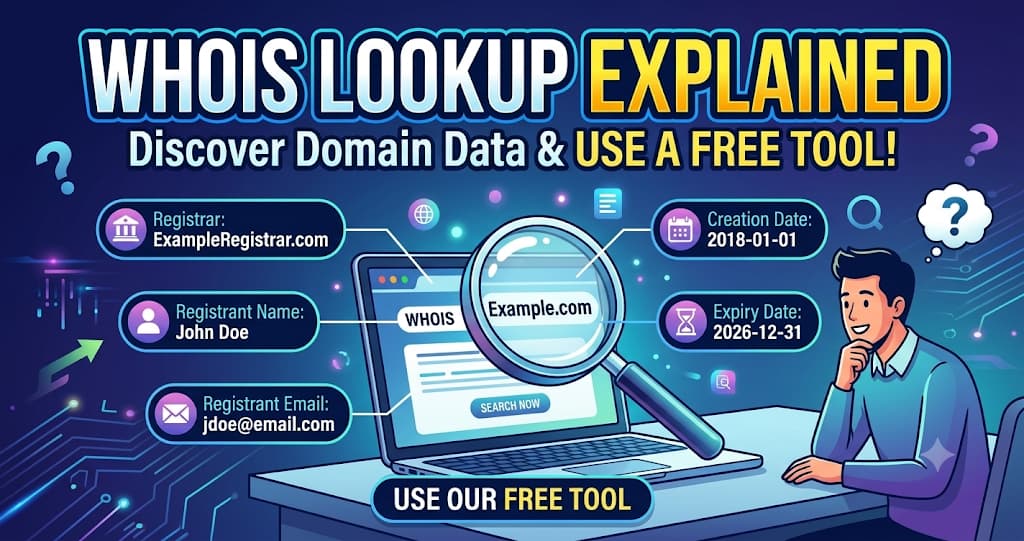
WHOIS used to show a name and address for every domain. Since GDPR, most of that is hidden. Here's what you can still find, and how.
The internet crossed 401.6 million registered domain names by the middle of 2026, according to Verisign's latest count. Run a WHOIS lookup on most of them today and you will not see a name or an email address. You will see the words "REDACTED FOR PRIVACY."
This guide explains what a WHOIS lookup actually shows in 2026, why so much of it is hidden, and how to find who owns a domain when the public record will not tell you.
This guide explains what a WHOIS lookup actually shows in 2026, why so much of it is hidden, and how to find who owns a domain when the public record will not tell you.
Run a free lookup right now with the WHOIS Lookup tool on TraceMyIPOnline. Enter any domain and see what is public, no signup required.
People expect WHOIS to work the way it did ten years ago, with a full name and address for every domain. Since GDPR, that almost never happens anymore. What you can still get, reliably, is the registrar, the registration dates, and the nameservers, and that is usually enough to move an investigation forward.
—TMIO Editorial Team, TraceMyIPOnline
WHAT IS A WHOIS LOOKUP?
WHOIS is a public database that stores information about who registered a domain name, when, and through which company. A WHOIS lookup queries that database and returns whatever the registrar has published for a given domain.
Historically that included the registrant's name, organization, email, and phone number. Since the EU's GDPR took effect in 2018, most registrars mask that personal data by default, even for registrants outside Europe. An Interisle Consulting study found that 86.5% of domain registrants could no longer be identified through public WHOIS after ICANN's post-GDPR policy took hold, up from about 24% before the policy. The database did not disappear. It just stopped showing names.
HOW TO RUN A WHOIS LOOKUP IN 4 STEPS
1. Open the WHOIS Lookup tool. Type in the domain you want to check, with or without "www."
2. Read the registrar section first. This shows which company the domain was registered through, and it is almost never redacted.
3. Check the dates. Creation date, last updated date, and expiration date are public for nearly every domain, and they tell you how old the site is and whether it is close to lapsing.
4. Look at the nameservers. These show which DNS provider or hosting company the domain currently uses, which is often the fastest way to identify who is actually running the site.
WHAT A WHOIS LOOKUP SHOWS (AND WHAT IT USUALLY HIDES)
A typical 2026 WHOIS result splits cleanly into two groups.
● Usually public: registrar name, creation date, expiration date, last updated date, domain status codes, and nameservers.
● Usually redacted: registrant name, organization, street address, email, and phone number, replaced with text like "REDACTED FOR PRIVACY" or the registrar's own privacy proxy service.
The registrar-level data is often enough to work with. If you are checking whether a domain is legitimate, its age alone is a strong signal: a domain registered last week behaves very differently from one that has renewed every year for a decade. Domain status codes matter too. A code like "clientHold" means the registrar has suspended the domain, and "pendingDelete" means it is about to be released back into the public pool.
PUBLIC VS PRIVATE WHOIS REGISTRATION
Some registrants have never had public contact data to begin with, because they paid for privacy or proxy registration. That service replaces the registrant's real details with the proxy provider's own contact information, and it existed years before GDPR made redaction the default for everyone else.
The practical difference now is smaller than it used to be. Most registrants are redacted automatically, whether they opted into privacy protection or not. Where it still matters is legal process: a domain using paid privacy protection usually requires a formal request to the proxy provider to reveal the underlying registrant, while a domain redacted only by policy may release more through a documented WHOIS request through the registrar directly.
WHOIS LOOKUP FOR CALIFORNIA USERS
California businesses checking a competitor's or vendor's domain often want to know how established it is before signing a contract. The creation date answers that directly. A domain created three months ago claiming to be an "industry leader since 2010" is a mismatch worth noticing.
For trademark and business disputes specifically, California courts and the USPTO increasingly rely on registrar-of-record and nameserver history rather than registrant name, since the name is rarely available anymore. A WHOIS lookup still supports that kind of investigation, just with a different set of fields than it used to.
WHOIS LOOKUP FOR NEW YORK USERS
New York's concentration of media, finance, and legal firms means domain due diligence comes up constantly, whether it is verifying a vendor before a contract or checking a suspicious email domain during a security review. The registrar and creation date are usually the two fields that matter most in a first pass.
If a New York business needs registrant identity for a legal matter, such as a UDRP domain dispute or a subpoena, the path runs through the registrar, not through public WHOIS. ICANN requires registrars to retain registrant data even when it is not published, and to respond to properly filed legal requests.
WHOIS LOOKUP FOR LONDON USERS
UK businesses sit at the center of the GDPR redaction question, since the regulation exists specifically to protect data belonging to people connected to the EU and UK. A .uk domain registered by a UK individual will show heavily redacted WHOIS data by default, while a .uk domain registered by a UK company may show more, since GDPR protects personal data rather than corporate information.
Nominet, the .uk registry, runs its own WHOIS service separate from the global ICANN system, and it applies similar privacy rules. If you need registrant information for a .uk domain in a legal context, Nominet has its own disclosure process, distinct from how a .com or .org request would work.
WHOIS LOOKUP FOR TORONTO USERS
Canadian domains under .ca are managed by CIRA, which has its own WHOIS privacy policy, generally stricter than the ICANN default even before GDPR existed. Individual .ca registrants have had their contact information hidden by default for years, while organizations are typically shown.
For a Toronto business checking a .ca domain, the practical takeaway is not to expect personal contact data even from an older domain. Look at the registrar, the CIRA-assigned status, and the nameservers instead, and use CIRA's own request process if you need to go further.
BEFORE AND AFTER: WHOIS IN 2015 VS WHOIS IN 2026
These are made-up example values, but the shift they show is accurate.
● Registrant name — 2015: Jane Smith. 2026: REDACTED FOR PRIVACY.
● Registrant email — 2015: jane@example.com. 2026: Web form or proxy address.
● Registrant address — 2015: 123 Main St, Austin, TX. 2026: REDACTED FOR PRIVACY.
● Registrar — 2015: Example Registrar Inc. 2026: Example Registrar Inc. (unchanged)
● Creation date — 2015: 2015-03-12. 2026: 2015-03-12. (unchanged)
● Nameservers — 2015: ns1.examplehost.com. 2026: ns1.examplehost.com. (unchanged)
Three fields disappeared. Three stayed exactly as visible as they always were. That is the entire story of what GDPR changed for WHOIS, and it explains why an "IP tracker" or "WHOIS" search from ten years ago feels broken today even though the tool itself is not.
WHOIS LOOKUP TOOLS COMPARED
● Works on any TLD — TMIO WHOIS Lookup: Yes. Registrar's own WHOIS page: usually only TLDs they sell. ICANN Lookup (RDAP): Yes.
● No signup needed — TMIO: Yes. Registrar's page: usually. ICANN RDAP: Yes.
● Shows nameservers and dates — TMIO: Yes. Registrar's page: Yes. ICANN RDAP: Yes.
● Structured, machine-readable output — TMIO: via the site display. Registrar's page: rarely. ICANN RDAP: Yes, natively.
ICANN's own Lookup tool uses RDAP, the newer protocol replacing classic WHOIS, and it applies the same redaction rules. A registrar's own WHOIS page is often limited to domains sold through that registrar. A general-purpose lookup tool like ours works across every TLD without that restriction.
DOMAIN AND WHOIS STATISTICS FOR 2026
● There were 401.6 million registered domain names worldwide as of 30 June 2026, up 8.1% year over year (Verisign Domain Name Industry Brief).
● The domain market added 9.1 million new registrations in Q2 2026 alone, a 2.3% quarterly increase (Verisign).
● .com remains the largest single TLD with 163.6 million registrations as of Q1 2026 (Verisign).
● New generic TLDs (like .xyz, .shop, .top) grew 31.3% year over year, the fastest-growing category (Verisign/ZookNIC).
● 86.5% of gTLD domain registrants could not be identified through public WHOIS after ICANN's GDPR-driven redaction policy, up from about 24% before it (Interisle Consulting Group).
The redaction figure is a few years old now, but registrar behavior has not reversed since. If anything, more registrars default to full redaction today than when that study was published.
HOW TO FIND DOMAIN OWNER INFORMATION WHEN WHOIS IS REDACTED
Check the nameservers and hosting. Even when the registrant is hidden, the hosting provider often is not. A reverse lookup on the site's IP address can point to a hosting company, which is a legitimate channel for abuse reports.
Look for a registrar's WHOIS request form. Most registrars offer a contact form for legitimate reasons, such as trademark disputes or law enforcement requests, that routes to the actual registrant without exposing their details publicly.
Use ICANN's RDAP-based Lookup for a UDRP or legal filing. For formal domain disputes, ICANN and WIPO have documented processes for requesting registrant data directly from registrars.
Check the website itself. A privacy policy, terms page, or "About" section often names the operating business even when WHOIS does not. Combine that with a DNS lookup on the domain's MX records, since the email provider can sometimes confirm which company controls it.
Accept that some domains will stay anonymous. Privacy protection exists for legitimate reasons too, including safety for individuals and small site owners. Not every WHOIS lookup is meant to end in a name.
FREQUENTLY ASKED QUESTIONS ABOUT WHOIS LOOKUPS
What is a WHOIS lookup?
A WHOIS lookup queries the public database of domain registration records and returns what a registrar has published for that domain, typically including the registrar name, key dates, and nameservers.
Why does WHOIS show "REDACTED FOR PRIVACY"?
Since the EU's GDPR took effect, most registrars mask personal registrant data by default to comply with data protection law, even for registrants outside the EU. This replaced what used to be full contact details for nearly every domain.
How do I find out who owns a domain if WHOIS is redacted?
Check the registrar's own contact request process, look at the hosting provider through a reverse IP lookup, review the website's own contact or privacy pages, and use formal legal channels like a UDRP filing for trademark disputes.
Is WHOIS data still public?
Registrar, creation date, expiration date, and nameserver information remain public for nearly all domains. Personal registrant details are usually hidden, but the domain's infrastructure and history are still visible.
What is the difference between WHOIS and RDAP?
RDAP is the newer, structured protocol that is gradually replacing classic WHOIS, returning the same kind of data in a machine-readable format. Both apply the same privacy redaction rules for personal information.
Can I hide my own domain's WHOIS information?
Most registrars redact personal data by default now, and many also offer a separate privacy or proxy protection service for additional coverage, depending on the TLD and registrar.
How can I tell how old a domain is?
The creation date field in a WHOIS lookup shows when the domain was first registered. This is one of the few fields that stays public even when registrant details are hidden.
What does "pendingDelete" mean in a WHOIS result?
It means the domain was not renewed and is in the final stage before being released back into the public pool for anyone to register. Domain status codes like this remain visible in WHOIS.
Does WHOIS show who is hosting a website?
Not directly, but the nameservers field often reveals the DNS provider, which frequently points to the hosting company. A separate DNS lookup or reverse IP search can confirm it.
Is a WHOIS lookup legal?
Yes. WHOIS is a public database maintained under ICANN policy, and looking up any domain's public records is a normal, legal part of registering, buying, or investigating a domain.
Ready to check a domain? Run the free WHOIS Lookup tool now, no signup needed. If you also want to see the domain's DNS records, the DNS Lookup tool covers that in one click.