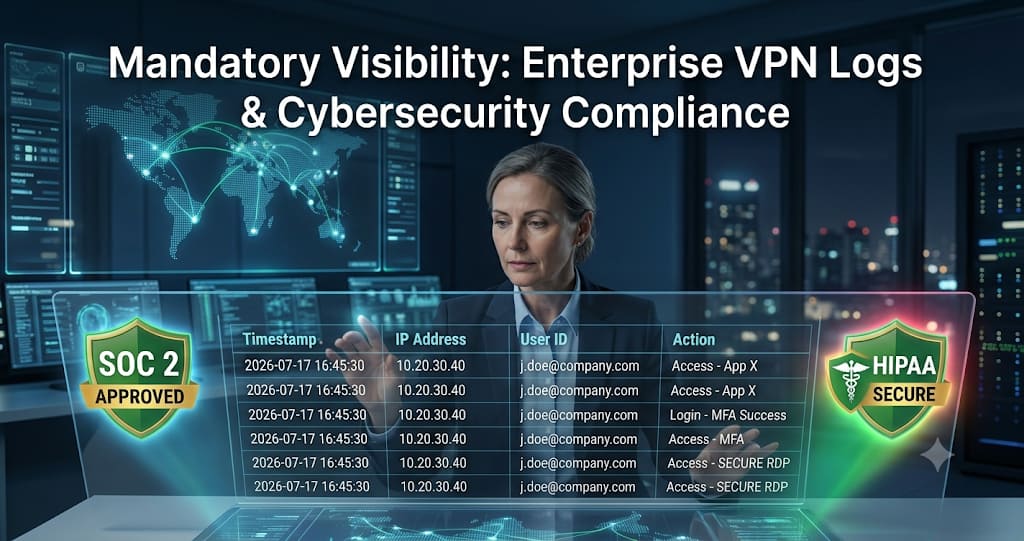
In the consumer world, a "strict no-logs policy" is the ultimate selling point for a VPN. In the corporate enterprise world, a no-logs policy is illegal. For organizations operating in heavily regulated environments, lacking a perfect audit trail of who accessed your network, from where, and at what time guarantees a failed compliance audit. Discover why migrating to an Enterprise VPN with centralized SIEM logging is the only way to achieve SOC 2, HIPAA, and GDPR compliance in 2026.
There is a fundamental misunderstanding in the remote work era regarding VPN privacy. When an individual buys a VPN to browse the web at home, they demand a "No-Logs" policy so the provider cannot track their internet history. However, when an IT Director deploys a VPN for remote employees to access corporate servers, the exact opposite is true. Corporate security is built on accountability, not anonymity.
If a data breach occurs and your organization cannot produce a precise log of which user account and which IP address initiated the connection, you are flying blind. In 2026, regulatory bodies in the US, UK, and Europe require absolute forensic visibility. Network administrators must maintain comprehensive connection logs and frequently utilize tools like an IP address lookup tool to correlate VPN access logs with known safe geographic locations. A failure to log is a failure to comply.
"A corporate VPN without logging is just an unmonitored backdoor. If an auditor asks you who accessed the central database last Tuesday at 3 AM, and your answer is 'we don't keep logs,' you will fail your SOC 2 audit immediately and face massive regulatory fines." — Lead Compliance Architect, TraceMyIPOnline.
The Corporate Audit Trail: What Must Be Logged?
Enterprise VPNs and Zero Trust Network Access (ZTNA) gateways do not log what your employees are Googling on their personal time (especially if you utilize Enterprise VPN Split Tunneling). Instead, they log critical authentication and access metadata.
To pass a 2026 cybersecurity audit, your Enterprise VPN must export the following data to your central SIEM (Security Information and Event Management) system:
- Authentication Events: Successful logins, failed login attempts (crucial for spotting brute-force attacks), and MFA verifications.
- Session Metadata: Exact timestamp of connection, timestamp of disconnection, and total session duration.
- IP Intelligence: The user's assigned internal corporate IP, and their originating external public IP address.
- Access Destinations: Which specific internal servers, applications, or file shares the user requested access to during the session.
Before vs. After: Compliance Readiness
Audit Scenario | Consumer "No-Log" VPN | Enterprise Logging VPN / SASEData Breach Investigation | Impossible. No forensic trail exists. | Instant pinpointing of compromised account/IP.
SOC 2 Auditor Request | Fails controls for Access Monitoring. | Passes with automated, immutable SIEM logs.
Insider Threat Detection | Blind to employees downloading gigabytes of data. | Flags anomalous behavior and large data transfers.
Offboarding Verification | Hard to prove ex-employee access is fully revoked. | Log definitively shows no access post-termination.
SOC 2 Auditor Request | Fails controls for Access Monitoring. | Passes with automated, immutable SIEM logs.
Insider Threat Detection | Blind to employees downloading gigabytes of data. | Flags anomalous behavior and large data transfers.
Offboarding Verification | Hard to prove ex-employee access is fully revoked. | Log definitively shows no access post-termination.
Programmatic Compliance: Tier-1 Regulatory Frameworks (H2s)
Different regulations require different levels of network visibility. Here is how Enterprise VPN logs fulfill the legal requirements of major compliance frameworks in 2026.
SOC 2 Type II: Tech & SaaS (United States)
For SaaS companies, achieving SOC 2 Type II compliance is mandatory for closing enterprise deals. SOC 2 requires organizations to monitor for anomalies and unauthorized access to customer data. If your remote engineers connect to AWS via an unlogged VPN, you cannot prove that access is restricted to authorized personnel. Enterprise VPNs provide the immutable logs required by SOC 2 auditors to prove that logical access controls are actively functioning.
HIPAA: Healthcare Providers (United States)
The Health Insurance Portability and Accountability Act (HIPAA) enforces strict rules regarding electronic Protected Health Information (ePHI). Under the HIPAA Security Rule, organizations must implement hardware, software, and procedural mechanisms that record and examine activity in information systems containing ePHI. If a doctor uses an unmonitored connection to view patient files, it is a violation. Enterprise VPNs create a secure, logged tunnel that tracks exactly which practitioner accessed which medical database, a critical feature when Securing RDP Access with Enterprise VPNs.
GDPR & NIS2: Corporate Operations (European Union)
The EU's GDPR and the newer NIS2 Directive mandate strict data protection and rapid breach reporting (often within 72 hours). If a European financial firm suffers a breach via compromised remote access credentials, they cannot meet the 72-hour reporting window if they don't have logs to investigate. By routing traffic through an Enterprise VPN with a Dedicated IP, EU firms maintain the exact forensic trail needed to identify the scope of the breach, notify authorities, and avoid catastrophic fines.
PCI-DSS: Retail & E-commerce (Global)
Any business processing credit card data must comply with PCI-DSS. Requirement 10 explicitly states that organizations must "Log and monitor all access to system components and cardholder data." You cannot allow a remote IT admin to access the payment processing server without a deeply logged, MFA-secured VPN tunnel. The logs must be secured so they cannot be altered, which is why modern Cloud VPNs push logs directly to isolated, read-only SIEM storage.
Top Compliance-Ready Enterprise VPNs (Competitor Table)
If you are facing an upcoming IT audit, these B2B vendors provide the robust SIEM integrations and detailed logging required to pass.
Security Vendor | Compliance Logging Feature | Native SIEM Integrations | Best ForPerimeter 81 | Comprehensive Activity Monitoring | Splunk, Sentinel, AWS S3 | SOC 2 (SaaS / Tech)
Zscaler (ZPA) | Nanosecond-level Transaction Logs | All major SIEMs | Global Enterprises
Cisco Secure Access | Deep EDR & Network Logging | Cisco SecureX, QRadar | HIPAA (Healthcare)
NordLayer (B2B) | Basic Activity & Device Logs | Webhook APIs | SMEs / Startups
TraceMyIPOnline | IP Log Verification | N/A (Diagnostic Tool) | Compliance Auditors
Zscaler (ZPA) | Nanosecond-level Transaction Logs | All major SIEMs | Global Enterprises
Cisco Secure Access | Deep EDR & Network Logging | Cisco SecureX, QRadar | HIPAA (Healthcare)
NordLayer (B2B) | Basic Activity & Device Logs | Webhook APIs | SMEs / Startups
TraceMyIPOnline | IP Log Verification | N/A (Diagnostic Tool) | Compliance Auditors
2026 Cybersecurity Compliance Statistics
- Audit Failures: 45% of first-time SOC 2 Type II audit failures are directly attributed to inadequate remote access logging and monitoring.
- Ransomware Forensics: In ransomware events, companies with centralized Enterprise VPN logs identify the entry vector 70% faster than those without.
- Cyber Insurance: In 2026, 85% of enterprise cyber insurance policies explicitly deny payouts if the organization cannot provide access logs for the compromised network segment.
Frequently Asked Questions (FAQ)
1. Doesn't VPN logging violate employee privacy?
In a corporate setting, privacy expectations are different. Enterprise VPNs log metadata (when you connected, which corporate server you accessed) for security, not personal surveillance. If split tunneling is used, your personal internet browsing (like YouTube) is not routed through the corporate VPN and is therefore not logged.
2. Why are consumer "no-log" VPNs dangerous for business?
Because if a hacker steals an employee's credentials and uses a consumer VPN to access your network, you will have absolutely no record of the intrusion. You cannot investigate what you cannot see.
3. What is a SIEM, and why does my VPN need to connect to it?
SIEM (Security Information and Event Management) is a centralized software system that collects and analyzes security logs from all your company's tools. Pushing VPN logs to a SIEM allows security teams to use AI to spot anomalous behavior across the entire network instantly.
4. How long do we need to keep our VPN logs?
This depends strictly on your compliance framework. SOC 2 often expects 6 to 12 months of log retention, while HIPAA and PCI-DSS can require keeping audit trails for up to one to three years.
5. Can an administrator alter the VPN logs to hide a breach?
Modern Enterprise VPNs are designed to stream logs in real-time to write-once, read-many (WORM) storage. This means once the log is created, not even a high-level system administrator can delete or alter the record, ensuring true compliance.
Contact Us: admin@tracemyiponline.com | Website: https://www.tracemyiponline.com