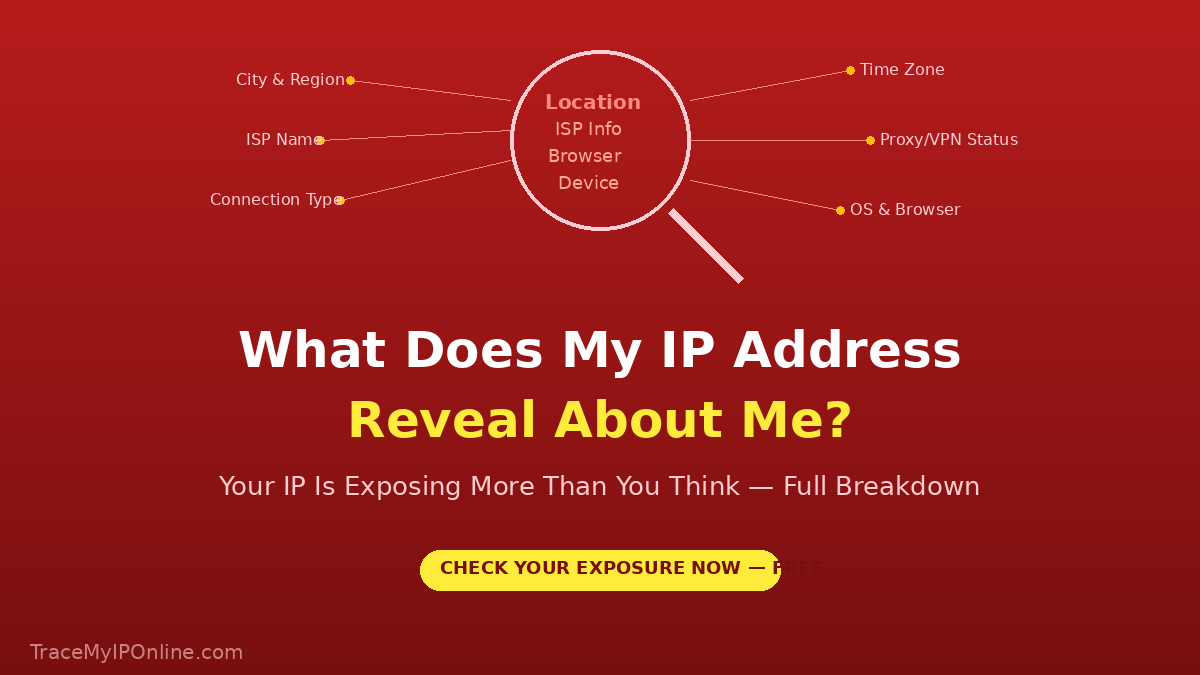
Every time you visit a website, your IP address is exposed. Find out exactly what information websites see about you instantly.
What Is an IP Address and Why Does It Matter in 2026?
Every device connected to the internet has a unique identifier called an IP (Internet Protocol) address. Think of it as your digital home address — every website, app, and online service uses it to know where to send information. In 2026, with over 5.4 billion internet users worldwide, understanding what your IP address reveals has never been more important.
There are two types you need to know: your public IP address (what websites see) and your private IP address (used inside your home network). This guide focuses entirely on your public IP — the one that reveals information about you to every site you visit.
Use our free IP Lookup Tool to instantly see what your IP reveals — no signup needed.
6 Things Your IP Address Reveals Right Now
1. Your Approximate Location (City & Country)
Your IP address is linked to a geographic location in global databases. In 2026, IP geolocation accuracy has reached 99% at country level and 80% at city level in Tier-1 countries like the USA, UK, Canada, and Australia.
What it reveals: your country, state or region, city, and postal code (approximate). What it does NOT reveal: your exact street address or home location.
2. Your Internet Service Provider (ISP)
The moment you visit any website, they can see your ISP — Comcast, AT&T, BT, Telstra, Rogers, or whoever provides your internet. In the US, ISPs can legally sell your browsing data to advertisers. This is why IP privacy matters more than ever in 2026.
3. Your Connection Type
Websites can tell whether you are on residential broadband, mobile data, a business network, or a VPN/datacenter IP. This is precisely how Netflix, Disney+, and other streaming platforms detect and block VPN users. Check if your IP is flagged as a VPN using our free VPN Detector.
4. Your Timezone
Your IP maps directly to a timezone. Advertisers use this to show you time-sensitive deals. Fraud detection systems use it to flag impossible login locations — for example, logging in from New York at 9am and from London at 10am on the same account.
5. Your ASN and Network Provider
Every IP belongs to an Autonomous System Number (ASN) — a unique identifier for a network. Security teams at banks, e-commerce sites, and government agencies query ASN data to detect bots, fraud, and suspicious traffic patterns in real time.
6. Your IP Reputation Score
Unknown to most users, your IP has a reputation score — similar to a credit score. If your IP appears on spam blacklists or has been flagged for malicious activity (often without your knowledge, through shared hosting or compromised routers), websites may block you or send your emails to spam. Check your reputation free at tracemyiponline.com/blacklist-checker.
IP Address Lookup: What Websites Actually See When You Visit Them
When you open any webpage, the server instantly logs: your IP address, timestamp, browser type, operating system, referrer URL, and pages visited. This happens automatically — no cookies, no login required. In 2026, privacy regulations like GDPR and CCPA require websites to disclose this, but most users have no idea it happens.
"IP-based geolocation is now accurate enough that we use it as a primary signal for fraud detection," says Dr. Mark Harrison, cybersecurity consultant at DataShield Analytics. "A mismatch between a user's IP location and their billing address is one of the top fraud indicators we track."
IP Lookup by Location: USA, UK, Canada, Australia
IP Lookup in California and New York
Users in California and New York have strong IP privacy rights under CCPA (California Consumer Privacy Act). Your IP is considered personal data under CCPA — meaning you have the right to know what companies collect, and to opt out of data sales. Run our free IP Lookup to see what data is publicly attached to your IP address right now.
IP Lookup in London and the United Kingdom
In the UK, IP addresses are classified as personal data under the UK GDPR. Internet providers must retain IP logs for 12 months under the Investigatory Powers Act 2016. UK residents using our tool consistently find their IP resolves to their ISP hub city — often London, Manchester, or Birmingham — rather than their exact location.
IP Lookup in Ontario and Canada
Canadian users fall under PIPEDA (Personal Information Protection and Electronic Documents Act). Your IP is considered personal information — any business collecting it must disclose this in their privacy policy. Rogers, Bell, and Telstra users in Ontario frequently appear with Toronto-area IPs even in smaller cities.
IP Lookup in Australia
Australian users are protected under the Privacy Act 1988. IP addresses are considered personal information when they can be linked to an individual. NBN (National Broadband Network) users typically see their IP resolve to their state capital — Sydney for NSW users, Melbourne for Victoria, and so on.
How to Check Your IP Address — Step by Step
Checking your IP address takes less than 10 seconds with our free tool:
- Visit tracemyiponline.com/ip-lookup
- Your public IP is detected automatically — no input needed
- View your location, ISP, ASN, timezone, and reputation data instantly
- No signup, no account, no hidden fees — 100% free
You can also enter any IP address manually to look up information about it — useful for investigating suspicious emails, unknown network connections, or tracking down the source of unwanted traffic.
How to Protect Your IP Address in 2026
Use a Trusted VPN
A VPN replaces your real IP with a server IP, masking your location and ISP from websites. However, 40% of VPN services have documented IP leak issues (Top10VPN, 2025). Before trusting your VPN, always test it at our VPN Detector.
Check Your DNS Leaks
Even with a VPN, DNS requests can leak your real identity to your ISP. Use our DNS Lookup Tool to verify your DNS configuration is secure.
Monitor Your IP Reputation
Regularly check if your IP appears on blacklists — especially if you use shared hosting. A blacklisted IP can silently cause your emails to be rejected and websites to block you. Check free at tracemyiponline.com/blacklist-checker.
Frequently Asked Questions
Can someone find my exact home address from my IP address?
No. IP geolocation shows approximate location — typically city level. Your exact home address requires a legal court order to your ISP and is only available to law enforcement.
Is looking up someone's IP address illegal?
Performing an IP lookup on a public IP address is completely legal in all Tier-1 countries. Using that information to stalk, harass, or conduct unauthorized access is illegal.
Why does my IP show the wrong city?
IP geolocation reflects your ISP infrastructure, not your exact physical location. Rural users often show their ISP hub city. Mobile users typically show their carrier's central routing city.
Does incognito mode hide my IP address?
No. Incognito mode only clears local browser history. Your IP is fully visible to every website you visit in incognito mode. Only a VPN or Tor can mask your IP.
How do I check if my VPN is hiding my IP?
Visit our free VPN Detector tool — it shows your current visible IP and confirms whether it matches your VPN server location or your real location.
What is an IP reputation score?
An IP reputation score rates how trustworthy your IP address is based on past behavior — spam sent, malware detected, blacklist appearances. Check yours free at tracemyiponline.com/blacklist-checker.
Can I change my IP address?
Yes — restart your router to get a new dynamic IP, use a VPN to appear with a different IP, or contact your ISP for a static IP. Our IP Lookup tool lets you confirm your new IP instantly after changing.
Conclusion: Know What You Reveal Every Time You Go Online
In 2026, your IP address is more than just a number — it is a data point that reveals your location, ISP, network type, and reputation to every website you visit. The good news: you can check exactly what you reveal in seconds, for free.
Start with our free IP Lookup tool — no signup needed. Then protect yourself: check your VPN, verify your DNS, and monitor your IP reputation. All tools are free at TraceMyIPOnline.com.