If you have ever looked up an IP address and seen something like AS7922 Comcast Cable Communications or AS13335 Cloudflare in the results, you have seen an ASN. Most people skip past it. Security professionals treat it as one of the more useful data points in an IP lookup — sometimes more useful than the city-level location. Here is why, and how to read it.
ASN Numbers Show Up Everywhere in Network Security — Here Is What They Actually Mean
If you have ever looked up an IP address and seen something like "AS7922 Comcast Cable Communications" or "AS13335 Cloudflare" in the results, you have seen an ASN. Most people skip past it. Security professionals treat it as one of the more useful data points in an IP lookup — sometimes more useful than the city-level location.
ASNs are not obscure. They are the organizational backbone of how the internet routes traffic, and they turn an IP address from a raw number into a piece of contextual information: who operates this network, what type of network is it, and what does that imply about the traffic coming from it.
Check any IP address's ASN and full network profile free at tracemyiponline.com/ip-lookup — no signup needed.
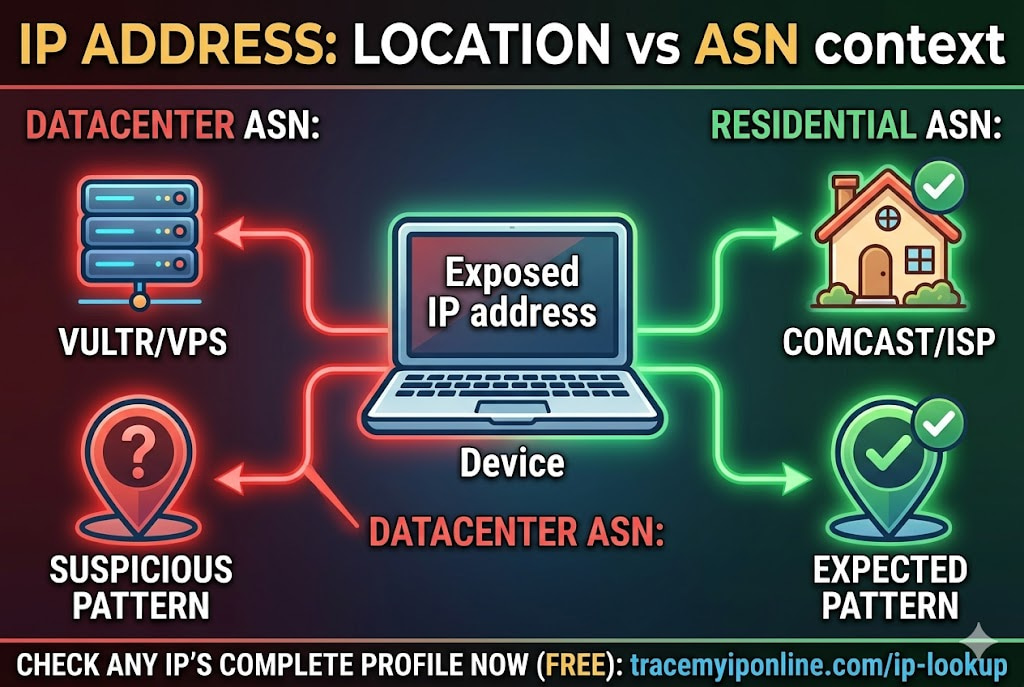
"In threat intelligence work, ASN context often matters more than geographic location. An IP from AS14061 tells me immediately I am looking at a DigitalOcean cloud server — likely a VPS running automated traffic. An IP from AS7922 tells me residential Comcast — probably a real user. The ASN classification shapes the entire risk interpretation. A login from a datacenter ASN to a consumer banking account is inherently suspicious in a way that a residential ISP login is not, regardless of what city the IP geolocates to."
— Dr. Amara Singh, Threat Intelligence Researcher, Coventry University Centre for Cybersecurity
What an ASN Is — The Simple Explanation
The internet is not one network. It is tens of thousands of separate networks — operated by ISPs, universities, companies, governments, and cloud providers — that interconnect and exchange traffic according to agreed routing protocols.
An Autonomous System (AS) is one of these independently operated networks. An Autonomous System Number (ASN) is the unique identifier assigned to each one. When networks connect and exchange routing information, they use these numbers to identify themselves and announce which IP address ranges they control.
The Internet Assigned Numbers Authority (IANA) delegates ASN assignment to Regional Internet Registries: ARIN (Americas), RIPE NCC (Europe and Middle East), APNIC (Asia-Pacific), LACNIC (Latin America), and AFRINIC (Africa). Each of these registries maintains public WHOIS data that maps ASNs to their registered owners.
What this means practically: when you see an ASN in an IP lookup result, you are seeing which organization's network that IP belongs to. The organization name that appears is whoever registered that AS with the relevant RIR.
How to Look Up Any IP's ASN
The simplest method is our free IP Lookup tool. Enter any IP address and the results include the ASN, registered organization name, and network range — all from the public RIR databases, displayed without requiring any registration.
What the results tell you:
ASN number (e.g., AS15169): The unique identifier. The number itself is not meaningful beyond identification — AS15169 happens to be Google.
Organization name: Who registered the AS. This is the most human-readable part. "Google LLC," "Amazon.com Inc," "Comcast Cable Communications" — these tell you immediately who operates the network.
IP range (CIDR block): The range of IP addresses controlled by this AS. Tells you the scale of the network and whether neighboring IPs belong to the same organization.
Network type classification: Some lookup tools, including ours, classify ASNs as residential ISP, datacenter/hosting, enterprise, education, or government — based on the registered owner and network characteristics. This classification is often more useful than the raw ASN number.
Why ASN Classification Matters — Practical Applications
Distinguishing real users from bots: Bot traffic, scrapers, and automated tools typically originate from cloud hosting ASNs — AWS (AS16509), Google Cloud (AS15169 or AS396982), DigitalOcean (AS14061), OVH (AS16276), and similar. Real human users connect from residential ISP ASNs. Security systems use this classification to score login attempts, ad clicks, and form submissions.
VPN detection: VPN providers use datacenter IP ranges. A user claiming to be in London connecting from AS9009 (M247 — a common VPN provider) is using a VPN. Streaming services, banking platforms, and fraud detection systems use ASN classification to identify VPN use. Check whether your IP is flagged at tracemyiponline.com/vpn-detector.
Fraud detection: A payment from an IP on a residential US ISP ASN matches the expected pattern for a US customer. The same payment from an IP on a Romanian hosting ASN does not — even if the IP geolocates to "United States." ASN context catches inconsistencies that geographic location alone misses.
Email authentication: Email security systems check whether the sending IP's ASN matches what would be expected for the domain's registered mail infrastructure. An email claiming to be from a major bank sent from a residential ISP ASN in a different country fails this check immediately.
Attack traffic attribution: When analyzing attack traffic, ASN information helps identify whether attacks are coming from organized infrastructure (datacenter ASNs suggesting a well-resourced attacker) or compromised home computers (residential ASNs suggesting a botnet of infected devices).
Major ASNs You Will See Frequently
These are ASNs that appear constantly in IP lookup results and security investigations:
AS7922: Comcast Cable Communications — the largest residential broadband ISP in the United States. An IP on AS7922 is almost certainly a US residential connection.
AS15169: Google LLC — includes Google's search infrastructure, Google Cloud, Google DNS servers (8.8.8.8), and various Google services.
AS16509: Amazon.com Inc — Amazon Web Services. One of the most common ASNs in security investigations because so much software and automation runs on AWS.
AS13335: Cloudflare Inc — includes Cloudflare's CDN infrastructure, 1.1.1.1 DNS, and DDoS protection. Many websites show a Cloudflare ASN rather than their own because Cloudflare proxies their traffic.
AS14061: DigitalOcean — popular VPS hosting provider. Frequently seen in bot traffic and automated scanning.
AS9009: M247 Ltd — commonly used by VPN providers for their server infrastructure. Seeing this ASN is a strong indicator of VPN use.
AS20473: Vultr Holdings LLC — another VPS provider frequently appearing in automated traffic and VPN infrastructure.
Before vs After: ASN Analysis Catches What Location Data Misses
Scenario — fraud detection for a US-based e-commerce checkout:
Purchase attempt: IP geolocates to Chicago, Illinois, USA. Looks like a legitimate US user. Standard location check: pass.
ASN check: AS20473 (Vultr — VPS hosting). This IP belongs to a virtual server, not a residential connection. No legitimate Chicago resident shops from a datacenter VPS. Fraud score: elevated. Additional verification required.
Outcome: Order flagged and sent for manual review. The card was a stolen number being tested by a fraud operator running software on a VPS. The location data would have passed the check. The ASN check caught it.
For California and New York Developers and Security Teams
California's CCPA creates accountability for systems that process personal data — including IP-based fraud detection. Security teams at California-based companies need to understand their traffic's ASN distribution to build effective fraud signals without creating discriminatory patterns against legitimate users.
New York's financial regulatory environment (NYDFS Part 500) requires covered institutions to implement risk-based cybersecurity programs. ASN-based access control — flagging logins from unexpected network types — is a standard component of these programs. Understanding ASN lookup and how to interpret results is relevant for both technical implementation and regulatory documentation.
For London and UK Security Professionals
The UK's NCSC guidance on identity and access management includes network-based risk signals as recommended controls. ASN classification — residential vs. datacenter, expected geographic region vs. anomalous — is a practical implementation of this guidance for organizations operating identity verification systems.
Under UK GDPR, any automated decision-making system that significantly affects individuals (credit decisions, fraud flags, access denials) must be explainable. ASN-based decisions — "this login came from a datacenter IP, which is inconsistent with this account's history" — are more explainable than black-box risk scores. Our IP Lookup tool gives London-based teams instant access to the same data underlying these decisions.
For Toronto and Ontario IT Professionals
Canadian PIPEDA requires organizations to implement appropriate security safeguards. Network-based authentication signals, including ASN-based classification, are increasingly referenced in OPC guidance as examples of appropriate technical measures for systems handling personal information.
Ontario-based financial institutions subject to OSFI (Office of the Superintendent of Financial Institutions) guidelines should consider ASN context in their login risk assessment frameworks. The pattern — residential ISP ASN matching the customer's registered location, vs. datacenter ASN from a different country — is a straightforward and explainable risk signal. Verify any IP's ASN free at tracemyiponline.com/ip-lookup.
For Sydney and Australian Security Teams
The ACSC's Essential Eight framework and various APRA (Australian Prudential Regulation Authority) standards for financial institutions reference identity verification and access control. ASN-based contextual signals fit within these frameworks as network-layer authentication signals.
Australian businesses handling consumer financial data under ASIC oversight should be aware that ASN classification data is available as a free, public resource. Building risk signals on publicly available network registration data is both technically appropriate and defensible under privacy-by-design principles. Check any IP's network classification at tracemyiponline.com/ip-lookup.
How ASNs Connect to Other Network Tools
ASN + WHOIS: WHOIS lookup on the ASN (as opposed to a domain) queries RIR databases directly and returns the full registration record for the network block. This is how researchers verify whether an ASN belongs to the organization claimed. Use our WHOIS Lookup to check domain-level ownership alongside IP lookup for complete investigation context.
ASN + Reverse IP: Within a large corporate ASN, many IPs may host many different services. Reverse IP lookup shows what domains are hosted at a specific IP within that ASN. Useful for mapping an organization's web presence. Use our Reverse IP tool.
ASN + Blacklist Check: Some ASNs have reputational issues — particularly hosting providers that are lax about abuse complaints. Checking whether an ASN frequently appears on blacklists is a useful signal when evaluating traffic from that network range. Use our Blacklist Checker.
Frequently Asked Questions
Is the IP lookup tool (which shows ASN) completely free?
Yes — 100% free, no signup, no account. Visit tracemyiponline.com/ip-lookup, enter any IP, and see the full profile including ASN and organization name instantly.
Can I look up what ASN my own network uses?
Yes — visit tracemyiponline.com/ip-lookup without entering an IP and your current public IP's ASN appears automatically along with your ISP name and other details.
Are all IPs within an ASN owned by the same company?
The ASN is registered to one entity, but that entity may assign or lease IP space within their range to other organizations. The top-level registration belongs to the AS holder, but sub-assignments are common in large provider networks.
What is the difference between an ASN and an IP range?
An ASN identifies the autonomous system — the organization and network. An IP range (CIDR block, like 104.16.0.0/12) is the specific set of IP addresses that AS controls. One ASN can control multiple non-contiguous IP ranges. The ASN is the identifier; the IP range is what it identifies.
Can two different organizations have the same ASN?
No — ASNs are unique identifiers globally. Each ASN belongs to exactly one registered organization. Transfers are possible (if an organization is acquired, the ASN may transfer), but at any given time, each number is associated with one entity in the RIR registry.
Why do some ASNs show as "bogon" or invalid?
Bogon ASNs are numbers that should not appear in global routing — either reserved ranges or numbers not yet assigned by RIRs. Traffic from bogon ASNs is inherently suspicious and is filtered by most network operators' border routers.
How is ASN information used in email spam filters?
Email spam filters check whether the sending IP's ASN is on shared blocklists, whether it is a datacenter ASN sending email claiming to be from a residential user, and whether the ASN matches the expected mail infrastructure for the claimed sender domain. An email sent from a random datacenter ASN claiming to be from a major bank fails all three checks. Check your IP's reputation at tracemyiponline.com/blacklist-checker.
The Practical Takeaway
For most internet users, ASNs are background infrastructure — useful to understand but not something you interact with directly. For anyone building fraud detection, analyzing traffic sources, investigating security incidents, or trying to understand what a specific IP address implies about its owner — ASN context is one of the most reliable pieces of information available.
An IP geolocates to a city. An ASN identifies a network. The combination tells you whether the claimed location and network type are consistent — which is often the most useful single piece of information in a security investigation.
Check any IP's complete profile including ASN at tracemyiponline.com/ip-lookup. Verify domain network configuration with our DNS Lookup. Check IP reputation with our Blacklist Checker. All free at TraceMyIPOnline.com.