A standard IP lookup tells you the ISP and location of an IP address. A reverse IP lookup does the opposite — it takes an IP and returns every domain name currently pointing to it. A shared hosting server might have hundreds of different domain names on the same IP. That neighborhood information tells you something important about the site you are investigating.
One IP Address Can Host Hundreds of Websites — Reverse IP Lookup Shows You All of Them
A standard IP lookup tells you the ISP and location of an IP address. A reverse IP lookup does the opposite — it takes an IP and returns every domain name currently pointing to it. A shared hosting server might have dozens, hundreds, or even thousands of different domain names on the same IP. That neighborhood information tells you something important about the site you are investigating.
"Reverse IP data is one of the first things I check when investigating suspicious domain infrastructure. A seemingly legitimate site that shares an IP with a cluster of newly registered domains using similar naming patterns is a meaningful signal. Individual domain lookups cannot show you this — you need to see the full hosting neighborhood to understand the context."
— Dr. Miriam Okafor, Threat Intelligence Research, University of Cape Town Cybersecurity Institute
Five Legitimate Uses of Reverse IP Lookup
1. Fraud investigation — checking a site's neighborhood: A site claiming to be a legitimate business but sharing an IP with 200 other recently registered domains follows a consistent fraud infrastructure pattern. The site you are looking at may appear clean — but if its neighbors are all 2-week-old domains with similar names, the infrastructure context tells a different story.
2. Explaining unexpected IP blacklisting: If your IP is blacklisted at tracemyiponline.com/blacklist-checker and you have done nothing wrong, a reverse IP lookup might explain why. A co-tenant on your shared server may be running spam operations, getting the shared IP blacklisted and affecting you.
3. Competitive research: Finding other domains registered to the same operator. A business with multiple domain names often points them all to the same server — reverse IP reveals the full portfolio.
4. Infrastructure mapping: Security researchers use reverse IP to understand how an organization's web infrastructure is organized. Which domains are on the same servers? Are there forgotten deprecated sites still pointing to active IPs?
5. Verifying enterprise claims: A business claiming enterprise-level operations but sharing a server IP with hundreds of other domains has a mismatch worth investigating. Genuine enterprise operations typically use dedicated servers where reverse IP returns one or a few domains.
Before vs After: Reverse IP in a Fraud Investigation
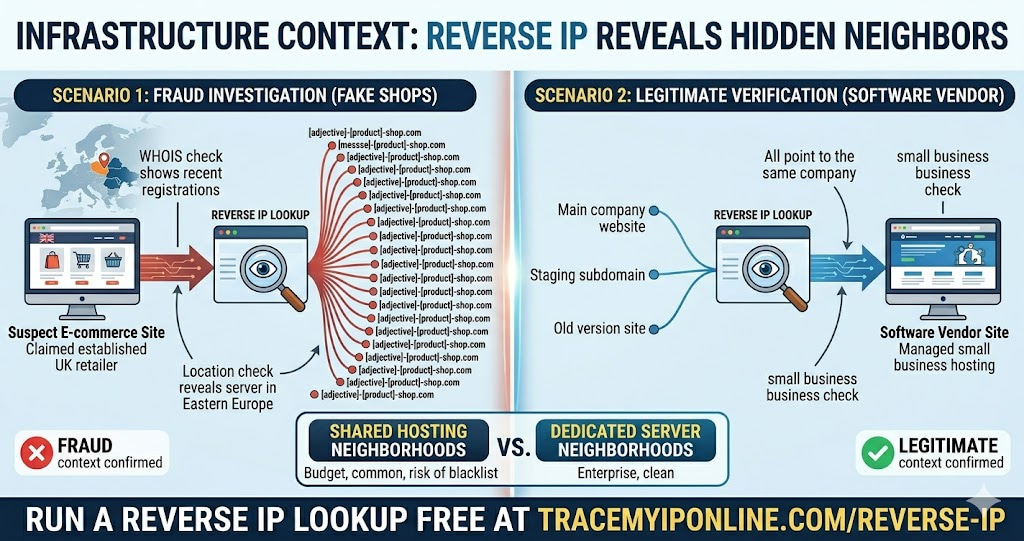
Scenario: E-commerce site claims to be an established UK electronics retailer. WHOIS shows 4-month-old domain. IP lookup shows server in Eastern Europe. Reverse IP lookup at tracemyiponline.com/reverse-ip: 340 other domains on the same IP, all registered within 6 months, all following the pattern [adjective]-[product]-shop.com.
This server is running a coordinated network of fake shops. The "established UK retailer" is one of 341 fake sites on the same infrastructure. ❌
Legitimate software vendor check: Reverse IP: 3 domains — main company website, a staging subdomain, and an old version of the site. All point to the same company. Consistent with a small business using managed hosting with dedicated IPs. ✅
For California and New York Users
California's consumer protection framework and the New York AG's consumer fraud division both investigate coordinated fake website networks. Reverse IP lookup is one of the investigative tools used to map these networks. For consumers who identify suspicious sites: a reverse IP check at tracemyiponline.com/reverse-ip showing the site shares infrastructure with hundreds of newly registered domains provides additional evidence for regulatory complaints.
For London and UK Users
Action Fraud and the NCSC investigate coordinated fraud infrastructure — fake parcel delivery notifications, investment platforms, and fake retailer sites sharing shared hosting clusters. For UK consumers: a reverse IP check combined with WHOIS data from tracemyiponline.com/whois-lookup and URL scanning at tracemyiponline.com/url-scanner provides a more complete picture of the fraud infrastructure for an Action Fraud report.
For Toronto and Ontario Users
The Canadian Anti-Fraud Centre investigates coordinated fake website networks. Ontario consumers who discover suspicious sites should check the reverse IP at tracemyiponline.com/reverse-ip — if the site shares infrastructure with similar fraudulent domains, include this in the CAFC report to help investigators map the scope of the operation.
For Sydney and Australian Users
Scamwatch and the ACCC investigate online scam operations including investment fraud and fake shopping sites. Australian consumers who find suspicious site clustering through reverse IP at tracemyiponline.com/reverse-ip should include this evidence in Scamwatch reports to help regulators understand whether they are looking at an isolated operation or a coordinated multi-site fraud network.
Reverse IP Limitations Worth Knowing
Shared hosting is normal: Most legitimate small websites are on shared hosting with many co-hosted domains. The relevant question is the pattern of those co-hosted domains — 500 established business sites is different from 500 recently registered look-alike fraud domains.
CDN and cloud infrastructure complicates this: Sites using Cloudflare or Akamai share IP ranges with millions of other sites. Reverse IP on a CDN IP returns data about the CDN's customers globally, not specifically the site you are investigating. For CDN-fronted sites, DNS-level investigation is more useful than IP-level.
Frequently Asked Questions
Is the Reverse IP Lookup tool free?
Yes — 100% free, no signup. Visit tracemyiponline.com/reverse-ip and check any IP's associated domains instantly.
I found a suspicious co-hosted domain — what should I do?
Document the full reverse IP results. Check suspicious co-hosted domains individually at tracemyiponline.com/whois-lookup to see their registration dates. Check the IP's reputation at tracemyiponline.com/blacklist-checker. If you find evidence of coordinated fraud, report to the relevant authority for your jurisdiction.
My IP is blacklisted but I have done nothing wrong — could reverse IP explain why?
Yes — this is one of the most common causes of unexplained blacklisting on shared hosting. A co-tenant on your server may be running spam operations. Confirm blacklisting at tracemyiponline.com/blacklist-checker, then run reverse IP at tracemyiponline.com/reverse-ip to see who else is on your server. If you identify bad neighbors, contact your hosting provider — they can move you to a clean IP block.
How many domains on a shared IP is normal?
Budget shared hosting: commonly 50-500 domains per IP. Standard shared hosting: 20-200. Business hosting: 5-50. Dedicated hosting: 1-5. The numbers vary significantly by provider and plan type.
Can CDNs like Cloudflare make reverse IP unreliable?
Yes — for sites behind Cloudflare or similar CDNs, reverse IP shows all sites using that CDN infrastructure globally, not specifically related sites. Check whether a site is CDN-fronted by looking at its name servers at tracemyiponline.com/dns-lookup. If name servers are Cloudflare's, reverse IP on the CDN IP is not useful — look at the DNS records instead.
Infrastructure Context Changes What You See
A website in isolation tells you what it claims about itself. A website in context — including what else is hosted on the same server — tells you something closer to the truth. Reverse IP is one piece of that context, available free, in seconds.
Run reverse IP at tracemyiponline.com/reverse-ip. Check WHOIS at tracemyiponline.com/whois-lookup. Check IP reputation at tracemyiponline.com/blacklist-checker. All free at TraceMyIPOnline.com.