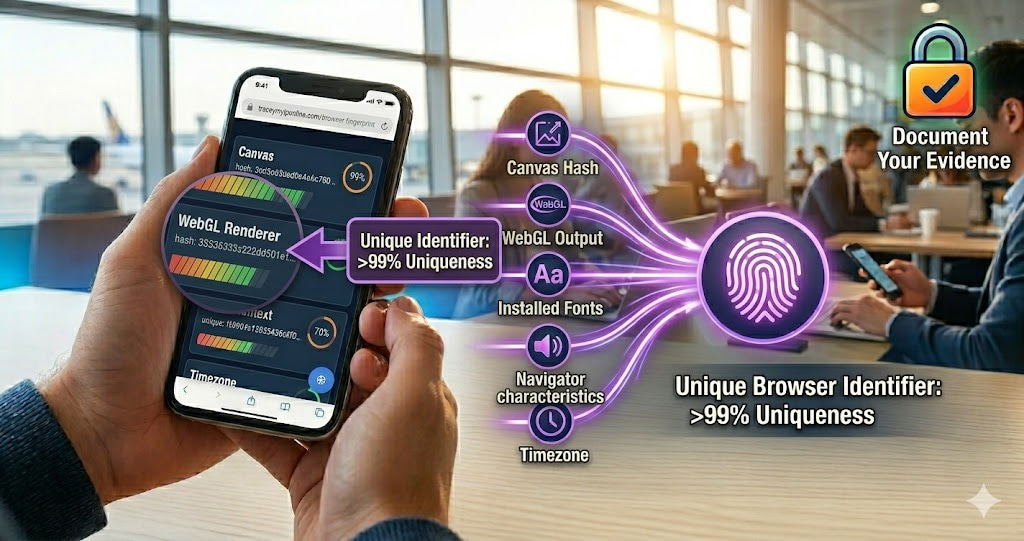
Browser fingerprinting is the practice of collecting technical characteristics of your browser and device to create a unique identifier. Unlike cookies, it requires no storage on your device and persists across cookie clears, incognito windows, and even some VPN configurations. Most people have never seen what their browser reveals. Here is the full picture.
Websites Can Identify Your Browser Without Cookies — Here Is What They Actually Collect
Browser fingerprinting is the practice of collecting technical characteristics of your browser and device to create a unique identifier. Unlike cookies, it requires no storage on your device and persists across cookie clears, incognito windows, and even some VPN configurations. The fingerprint is assembled from dozens of data points that individually seem innocuous but together are statistically unique to your specific browser setup.
This is not speculation — it is documented, measurable, and you can see exactly what your browser reveals right now.
Check your browser's fingerprint at tracemyiponline.com/browser-fingerprint — free, no signup, results in seconds.
"Browser fingerprinting has become the dominant tracking mechanism for users who block cookies or use privacy browsers. The combination of canvas fingerprinting, WebGL rendering output, audio context characteristics, installed font enumeration, and screen metrics creates identifiers with uniqueness rates exceeding 99% in some studies. Crucially, this fingerprint is device-level rather than browser-level — it survives browser updates, cookie deletion, and most privacy measures short of full browser isolation or active fingerprint spoofing."
— Prof. Elena Vasquez, Privacy Technology Research, Universidad Complutense de Madrid
What Data Points Make Up a Browser Fingerprint
A comprehensive browser fingerprint draws from multiple categories of browser and device information:
Canvas fingerprint: The browser renders a hidden image using the HTML5 Canvas API. Subtle differences in GPU drivers, operating system graphics subsystems, and installed fonts cause the rendered image to vary slightly between devices — even with the same browser on the same operating system version. This rendered image is hashed into a unique identifier. Canvas fingerprinting is highly stable and difficult to spoof accurately.
WebGL fingerprint: Similar to canvas fingerprinting but using the 3D graphics API. The WebGL renderer string reveals your GPU model and driver version. The rendered output of WebGL operations varies between graphics cards and drivers, creating another stable identifier.
Audio fingerprint: The Web Audio API processes a generated audio signal. Differences in audio hardware and software stacks cause subtle variations in the output that can be hashed into an identifier.
Screen properties: Screen resolution, color depth, pixel ratio (for high-DPI displays), and available screen area after taskbar. These narrow down your device significantly.
Navigator properties: User agent string (browser name, version, OS), language preferences, platform, hardware concurrency (CPU core count), device memory, and whether you have cookies and JavaScript enabled.
Installed fonts: By measuring which fonts are available and the exact dimensions of text rendered in each, fingerprinters can identify which fonts are installed on your system. This varies significantly between operating systems, users, and software installations.
Timezone and locale: Your system timezone, date/time format preferences.
Plugin and MIME type lists: In browsers that still expose these, installed plugins provide additional uniqueness.
Touch and pointer support: Whether your device supports touch input, stylus, etc.
Network characteristics: Combined with your IP address, these create a more complete identifier. Check your IP at tracemyiponline.com/ip-lookup.
How Unique Is Your Fingerprint — The Statistics
The Electronic Frontier Foundation's Panopticlick research found that approximately 83% of browsers had a unique fingerprint among their study participants. More recent studies using Canvas and WebGL fingerprinting found uniqueness rates above 99%.
What this means practically: if a tracking company collects your browser fingerprint across websites, they can identify you as the same user across different sites, across different sessions, and even across VPN connections — without any cookie, without any login, without your explicit consent to be tracked.
Run your own fingerprint check at tracemyiponline.com/browser-fingerprint to see what your browser reveals.
Before vs After: Fingerprint Visibility Across Privacy Measures
Regular Chrome browser — fingerprint check at tracemyiponline.com/browser-fingerprint: Canvas fingerprint: unique. WebGL renderer: NVIDIA GeForce RTX 3070/PCIe/SSE2. Audio fingerprint: unique. Screen: 2560x1440, 1x pixel ratio. Fonts: 47 detected. Browser: Chrome 124, Windows 11. This fingerprint has a uniqueness rate approaching 99.9% among browser populations.
Same user, incognito mode: Fingerprint check result: identical fingerprint. Canvas, WebGL, audio, screen, and font fingerprints are unchanged. Incognito mode does not affect any of these data points. Same identifier, same trackability. ❌
Same user, Firefox with strict mode: Canvas fingerprinting blocked (returns blank or noised data). WebGL renderer: obscured. Audio fingerprint: blocked. Some improvement — but screen resolution, timezone, and some navigator properties are still exposed. Partial protection.
Tor Browser: Canvas, WebGL, and audio fingerprinting blocked. Screen resolution reported as standard Tor Browser dimensions. Font enumeration blocked. Navigator properties standardized. Fingerprint is substantially shared with all other Tor Browser users — high anonymity set, very low uniqueness. Most comprehensive protection available in a mainstream browser, at a significant performance and convenience cost.
For California and New York Users: Fingerprinting and CCPA
California's CCPA defines "personal information" to include "browsing history" and "inferences drawn from other personal information to create a profile." Browser fingerprinting — which creates a persistent identifier linked to browsing behavior — is personal information under CCPA. The California Privacy Rights Act (CPRA) additionally grants California residents the right to opt out of "sharing" of personal information for cross-context behavioral advertising, which covers fingerprint-based tracking.
California residents have the right to opt out of fingerprint-based tracking through the Global Privacy Control (GPC) browser signal. Browsers that support GPC — Firefox, Brave, some Chrome extensions — automatically signal opt-out preferences to websites. Install a GPC-supporting browser or extension if fingerprint-based tracking is a concern.
New York currently lacks a comprehensive privacy law equivalent to CCPA, though several bills have been proposed. Federal FTC regulations on unfair or deceptive practices apply to some fingerprinting practices. Check what your browser reveals at tracemyiponline.com/browser-fingerprint.
For London and UK Users: Fingerprinting and UK GDPR/PECR
UK GDPR covers browser fingerprints as personal data when they can identify an individual or their device — which, given their 99%+ uniqueness rate, they almost always can. PECR (Privacy and Electronic Communications Regulations) requires consent for storing or accessing information on a user's device — while fingerprinting does not store anything on the device, regulators in several EU jurisdictions have found that fingerprinting still requires consent as it constitutes accessing device characteristics.
The ICO has published guidance on fingerprinting, noting that organizations using fingerprinting for tracking without adequate legal basis may be in violation of PECR and UK GDPR. For UK users concerned about fingerprinting: Firefox with strict mode, Brave, or Safari's Intelligent Tracking Prevention provide meaningful but imperfect protection. Check what your browser currently exposes at tracemyiponline.com/browser-fingerprint.
For Toronto and Ontario Users: Fingerprinting and PIPEDA
The OPC's position on browser fingerprinting is that where fingerprints can identify individuals or their devices, they constitute personal information under PIPEDA. Consent is required for the collection of personal information, and the purpose must be disclosed. The OPC's 2020 guidance on tracking pixels and similar technologies applies to browser fingerprinting by extension.
For Ontario users: the same browser privacy tools available to UK and California users apply. Understanding your current fingerprint exposure at tracemyiponline.com/browser-fingerprint is the starting point for evaluating whether additional privacy measures are warranted.
For Sydney and Australian Users: Fingerprinting and the Privacy Act
Australia's Privacy Act and the Australian Privacy Principles cover personal information that "identifies" or could "reasonably identify" an individual. A browser fingerprint with 99%+ uniqueness is plausibly identifiable personal information. The OAIC has not issued specific guidance on browser fingerprinting as of 2026, but the general principles of the APPs apply.
For Sydney and Melbourne users: browser fingerprinting is effectively unregulated in Australia compared to the EU/UK framework, but the technical tools for protection are the same. Check your current fingerprint exposure at tracemyiponline.com/browser-fingerprint.
What Actually Reduces Fingerprint Uniqueness
Tor Browser: The most effective approach. Standardizes all fingerprint vectors — canvas, WebGL, audio, screen resolution, fonts. All Tor Browser users look identical to trackers. Significant performance and convenience trade-off.
Brave Browser: Adds noise to canvas and WebGL fingerprints, making them change slightly between sessions. Combined with aggressive tracking protection, this significantly reduces persistent fingerprinting. Good balance of privacy and usability.
Firefox with Resist Fingerprinting: Firefox's privacy.resistFingerprinting setting blocks or standardizes many fingerprinting vectors. Enable in about:config. May break some sites.
Safari Intelligent Tracking Prevention: Apple's approach focuses on partitioning tracking data by site rather than blocking fingerprinting directly. Effective against cross-site tracking but does not address fingerprint uniqueness in the same way.
What does not work: Incognito/private mode (no effect on fingerprint), standard cookie blocking (fingerprinting bypasses cookies entirely), most VPNs (fingerprint is browser-level, not network-level).
Frequently Asked Questions
Is the Browser Fingerprint tool free?
Yes — 100% free, no signup. Visit tracemyiponline.com/browser-fingerprint and see exactly what your browser reveals instantly.
Does clearing cookies remove my browser fingerprint?
No. Browser fingerprints are not stored in cookies — they are assembled from browser and device characteristics each time a tracking script runs. Clearing cookies has no effect on your fingerprint. The same identifier can be reconstructed the moment you visit a fingerprinting site again.
Does a VPN prevent browser fingerprinting?
A VPN changes your IP address but does not affect browser fingerprinting. The fingerprint is assembled from browser characteristics — canvas rendering, WebGL output, screen size, installed fonts — none of which change when you connect to a VPN. Fingerprinting and IP-based tracking are separate mechanisms; a VPN addresses one but not the other. Check your VPN at tracemyiponline.com/vpn-detector.
Is browser fingerprinting illegal?
In the EU and UK, fingerprinting without consent may violate PECR/ePrivacy regulations. In California, it constitutes personal information collection under CCPA with associated rights. In most jurisdictions without comprehensive privacy laws, fingerprinting is legal though increasingly scrutinized by regulators.
Can I make my fingerprint less unique without switching browsers?
Somewhat. In Chrome or Firefox, installing uBlock Origin in strict mode blocks many fingerprinting scripts before they run. This does not eliminate the underlying fingerprinting vulnerability but reduces how often it is collected. For Chrome users, the Privacy Sandbox initiative is Google's attempt to replace cross-site fingerprinting with privacy-preserving alternatives — though its deployment and effectiveness continue to be debated.
The Track That Does Not Need Your Permission
Browser fingerprinting is the tracking mechanism that survives the privacy measures most people actually use. Understanding what your browser reveals is the prerequisite for deciding whether the convenience trade-offs of stronger protection tools are worth making for your specific situation.
Check your fingerprint at tracemyiponline.com/browser-fingerprint. See your IP at tracemyiponline.com/ip-lookup. Verify your VPN at tracemyiponline.com/vpn-detector. Check DNS at tracemyiponline.com/dns-lookup. All free at TraceMyIPOnline.com.