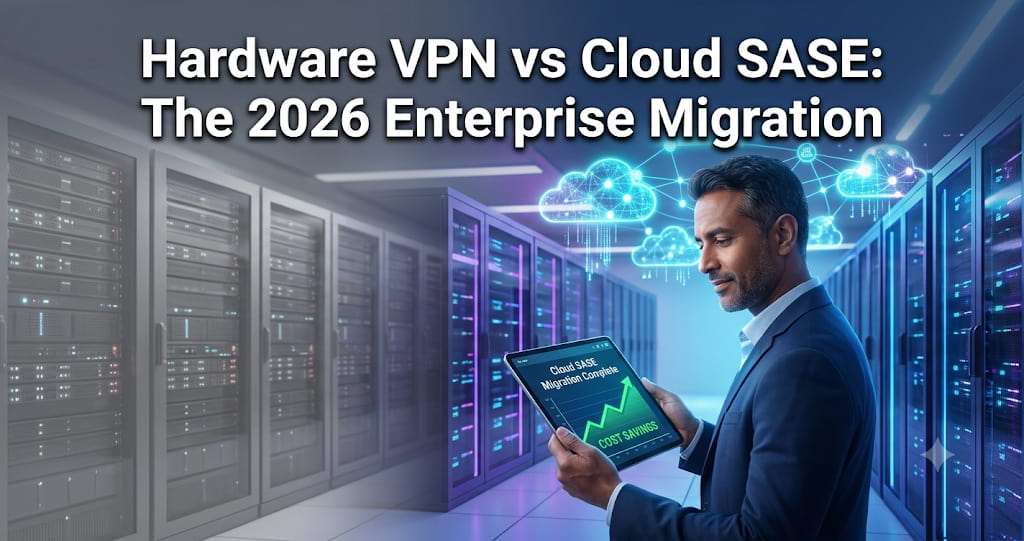
Physical VPN appliances are causing severe network bottlenecks for remote teams. In 2026, comparing Hardware VPN vs Cloud SASE is essential for IT budgeting. Discover how migrating to a cloud-native Zero Trust architecture eliminates hardware maintenance, boosts global speeds, and reduces overall IT infrastructure costs by up to 88%.
The era of maintaining racks of physical security appliances is rapidly coming to an end. In 2026, the debate between utilizing a traditional Hardware VPN vs a Cloud-native SASE (Secure Access Service Edge) platform is the defining factor in corporate IT budgeting. For the past two decades, enterprises secured their perimeters by purchasing expensive hardware VPN concentrators and installing them in centralized data centers. Today, with a globally distributed workforce accessing cloud applications, this hub-and-spoke model is fundamentally broken.
According to recent enterprise infrastructure audits, organizations that migrated from legacy hardware VPNs to cloud-native SASE architectures experienced up to an 88% reduction in ongoing IT maintenance and hardware refresh costs. Relying on physical appliances not only limits scalability but creates massive latency bottlenecks. If your remote teams are complaining about slow connections, it's time to run an IP address lookup tool diagnostic and audit your routing architecture.
"A hardware VPN forces global traffic through a localized physical box, creating a massive choke point. Cloud SASE flips the model: it puts the security perimeter in the cloud, right at the edge, closest to the user. In 2026, buying a physical VPN appliance is like buying a fax machine." — Lead Network Architect, TraceMyIPOnline.
The Hidden Costs of Physical VPN Gateways
When comparing a Hardware VPN to Cloud SASE, the initial sticker price is deceiving. A physical firewall or VPN concentrator requires physical rack space, dedicated power, advanced cooling, and constant manual patching by expensive IT personnel. Furthermore, hardware has a strict capacity limit. If your company suddenly hires 500 new remote employees, a physical VPN might crash under the load, forcing you to purchase, ship, and configure another physical box.
Cloud SASE and Cloud VPNs operate as a service. They are software-defined perimeters hosted on global server backbones. Scaling up to accommodate 5,000 new users takes a few clicks in an admin dashboard, with zero hardware deployment required.
Before vs. After: The Cloud Migration
Operational Metric | Legacy Hardware VPN (Before) | Cloud SASE / Cloud VPN (After)Scalability | Hard Limit. Requires buying new physical boxes. | Infinite. Scales instantly via software licensing.
Traffic Routing | "Hairpinning." All traffic forced to central HQ. | Direct-to-Cloud. Users connect to nearest global edge node.
Maintenance | Manual firmware patching; high risk of downtime. | Automatic cloud updates; zero maintenance windows required.
Capital Expense | Massive upfront CapEx for physical appliances. | Predictable OpEx subscription model.
Traffic Routing | "Hairpinning." All traffic forced to central HQ. | Direct-to-Cloud. Users connect to nearest global edge node.
Maintenance | Manual firmware patching; high risk of downtime. | Automatic cloud updates; zero maintenance windows required.
Capital Expense | Massive upfront CapEx for physical appliances. | Predictable OpEx subscription model.
Programmatic SASE Deployment: Geo-Targeted Case Studies (H2s)
Enterprise migration strategies vary based on the geographical distribution of the workforce and the location of critical data. Here is how major corporate hubs are handling the hardware-to-cloud transition in 2026.
Scaling Capacity: New York Financial HQs
Financial institutions in New York are notoriously reliant on heavy, on-premise hardware for high-frequency trading. However, for their remote analysts and back-office staff, maintaining hardware VPNs became unsustainable during market surges. By migrating these users to a Cloud SASE platform, NYC banks eliminated VPN gateway crashes during high-traffic trading days. The cloud architecture automatically spins up new virtual gateways to handle sudden influxes of remote logins, ensuring business continuity.
Latency Reduction: London Global Operations
London-based multinational corporations manage employees across Europe, Asia, and the Americas. Under a hardware VPN model, an employee in Tokyo had to route their traffic all the way to a physical box in London just to access a cloud-hosted CRM. This caused crippling latency. SASE providers have hundreds of Points of Presence (POPs) globally. Now, the Tokyo employee connects to a secure cloud node in Tokyo, slashing latency by hundreds of milliseconds. Before transitioning, IT teams used tools like TraceMyIPOnline and reviewed Enterprise VPN Performance Benchmarks to measure this exact latency drop.
Maintenance Elimination: Chicago Distribution Centers
In Chicago's logistics hubs, IT teams were spending thousands of hours driving to remote warehouses simply to patch or restart physical VPN appliances that connected local scanners to the main network. By moving to a cloud-managed SD-WAN and SASE model, Chicago logistics firms removed the physical VPNs entirely. Security policies are now pushed from a central cloud dashboard to lightweight edge routers, completely eliminating physical maintenance travel.
Security Investigations: Seattle Remote Tech Hubs
Seattle tech companies require extreme security without sacrificing developer speed. Cloud VPNs provide centralized logging that hardware appliances often struggle to aggregate. If a Seattle firm suspects an insider threat or a compromised developer account, investigators rely heavily on these cloud logs. For instance, if an employee is communicating suspiciously with unauthorized third parties, security teams might need to find the IP address of a Discord user or even find the IP address from an Instagram message and cross-reference those IPs with the immutable logs generated by the SASE platform to confirm a data exfiltration attempt.
Top Cloud VPN and SASE Vendors (Competitor Table)
If your enterprise is ready to decommission its legacy hardware, these are the leading cloud-native platforms dominating the B2B market in 2026.
Security Vendor | Architecture Type | Hardware Reliance | Best 2026 Enterprise Use CaseZscaler (ZIA/ZPA) | 100% Cloud-Native SASE | Zero Hardware Required | Global enterprises needing complete cloud transformation.
Palo Alto Prisma Access | Cloud SASE | Minimal (Edge routing) | Organizations transitioning from physical Palo Alto firewalls.
Cisco Umbrella/Secure Connect | Hybrid SASE | Integrates with Meraki | Businesses already deeply invested in Cisco infrastructure.
Cloudflare One | Cloud Network as a Service | Zero Hardware Required | Teams needing ultra-fast global edge performance.
TraceMyIPOnline | Web-Based Diagnostic | N/A (Web Tool) | Pre-migration network IP auditing and anomaly detection.
Palo Alto Prisma Access | Cloud SASE | Minimal (Edge routing) | Organizations transitioning from physical Palo Alto firewalls.
Cisco Umbrella/Secure Connect | Hybrid SASE | Integrates with Meraki | Businesses already deeply invested in Cisco infrastructure.
Cloudflare One | Cloud Network as a Service | Zero Hardware Required | Teams needing ultra-fast global edge performance.
TraceMyIPOnline | Web-Based Diagnostic | N/A (Web Tool) | Pre-migration network IP auditing and anomaly detection.
2026 Enterprise Network Statistics
- Hardware Decline: Sales of physical, standalone VPN concentrators have dropped by 62% globally as budgets shift entirely to cloud security.
- SASE Adoption: 80% of enterprises will have adopted a SASE architecture by the end of 2026, up from just 20% in 2021.
- Cost Savings: Mid-sized enterprises report saving an average of $250,000 annually on IT maintenance and hardware refresh cycles after migrating to cloud VPNs.
Frequently Asked Questions (FAQ)
1. What is the main difference between a Hardware VPN and a Cloud VPN?
A hardware VPN requires a physical appliance installed in your data center that users connect to. A Cloud VPN (or SASE) is hosted on a global network of servers by a provider. Users connect to the closest cloud node, entirely bypassing your physical infrastructure.
2. Is Cloud SASE more secure than a physical firewall?
In modern environments, yes. Cloud SASE platforms apply Zero Trust Network Access (ZTNA), deep packet inspection, and AI-driven threat prevention at the cloud edge, blocking threats before they ever reach your corporate network.
3. What does "hairpinning" mean in network routing?
Hairpinning is a massive flaw in hardware VPNs where remote user traffic is forced to travel to a central data center, only to immediately turn around and go out to the public internet (like Office 365). It doubles the travel distance and causes severe lag.
4. Will migrating to a Cloud VPN save my company money?
Yes. While cloud subscriptions have a monthly cost, they eliminate the massive capital expenditures of buying hardware, the operational costs of powering and cooling it, and the IT labor costs required to maintain it.
5. Do we have to replace all our hardware at once?
No. Most enterprises use a hybrid approach. They keep their physical firewalls for local office security but route all remote workers and cloud application traffic through the new SASE platform.
6. How do we audit our IP traffic during the migration?
During a migration, it is critical to use IP verification tools like TraceMyIPOnline. This ensures that the traffic hitting your cloud applications is successfully originating from your new SASE provider's IP blocks, rather than bypassing security protocols.
7. Can a Cloud VPN handle compliance requirements like SOC 2 and HIPAA?
Absolutely. In fact, they are often better suited for it. Leading SASE providers offer centralized, immutable logging that integrates directly into your SIEM, making compliance reporting much easier than pulling logs from multiple physical boxes. For more details, review our guide on Why Enterprise VPN Logs Are Mandatory for Compliance.
8. What happens if the SASE provider's cloud goes down?
Leading providers have massive global redundancy and SLAs guaranteeing 99.999% uptime. If one cloud node fails, user traffic is automatically and instantly routed to the next closest node without the user even noticing.
Contact Us: admin@tracemyiponline.com | Website: https://www.tracemyiponline.com