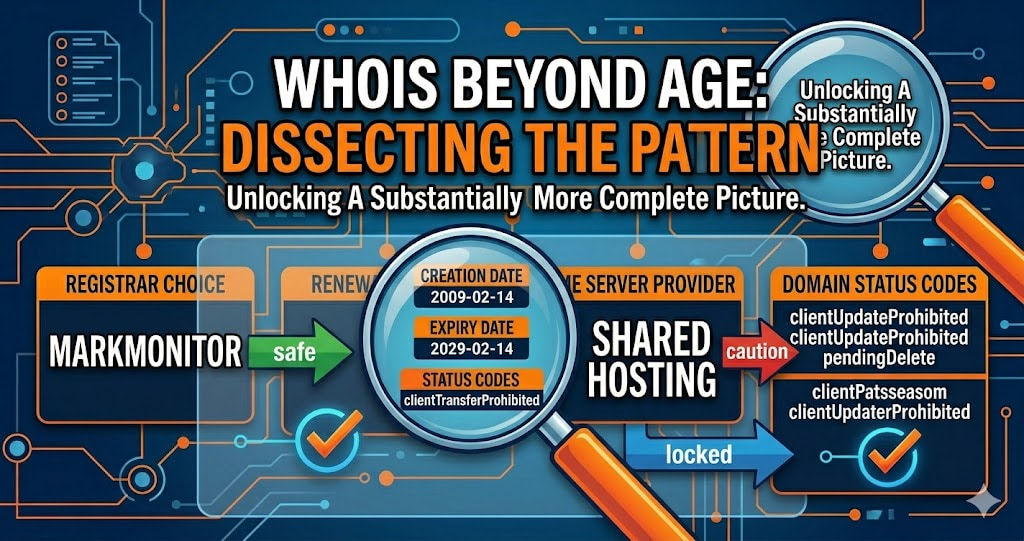
A WHOIS record has roughly twelve fields. Most guides tell you to look at the creation date and move on. That approach catches obvious fraud cases. But it misses the subtler signals that separate a well-organized fraud operation from a genuinely legitimate business.
Most People Check Domain Age and Stop — Here Is What They Are Missing
A WHOIS record has roughly twelve fields. Most guides tell you to look at the creation date and move on. That approach catches the obvious fraud cases — a site registered last Tuesday claiming to be a 20-year-old business is done. But it misses the subtler signals that separate a well-organized fraud from a genuinely legitimate business.
Reading the full record takes three minutes. This guide covers every field worth understanding.
Check any domain's complete WHOIS record free at tracemyiponline.com/whois-lookup — no account needed.
"Most people use WHOIS like a single-question test: how old is this domain? That is valuable, but it is only one signal. The combination of registration date, registrar choice, renewal pattern, name server provider, domain status codes, and registrant country — read together — gives a substantially more complete picture. I have seen scam sites with 5-year-old domains and legitimate new businesses registered last month. The full pattern matters more than any individual data point."
— Dr. Fatima Al-Rashid, Digital Forensics and Cybercrime Investigation, Dubai Police Academy
Field 1: Creation Date — The Most Important Single Field
When the domain was first registered. The APWG reported in 2025 that 95% of confirmed phishing sites were under 30 days old at first report. A site claiming 15 years of satisfied customers with a domain registered 6 weeks ago has a fundamental contradiction that no amount of professional design can explain away. Also compare creation date with last updated date — a domain updated very recently may have changed hands.
Field 2: Registry Expiry Date — The Underused Red Flag
Short registrations — exactly one year — indicate minimum commitment. Fraud operations register for one year because they do not expect to need the domain beyond their current campaign. Long renewals — five to ten years — are a positive indicator. Nobody pre-pays for ten years unless they expect to be around. An expiry date in the next two months on an actively soliciting site is a serious red flag.
Field 3: Registrar — Context, Not Condemnation
Enterprise domain registrars — MarkMonitor, CSC Global — are almost exclusively used by established corporations protecting valuable brand assets. Budget registrars with minimal verification requirements appear disproportionately in fraud investigations because low friction registration is attractive to anyone who needs many disposable domains quickly.
Field 4: Domain Status Codes — The Most Ignored Important Field
clientTransferProhibited: Domain locked against unauthorized transfer. Basic security feature present on most legitimate maintained domains.
clientUpdateProhibited: Registration data changes require additional verification. More common on high-value security-conscious domains.
clientDeleteProhibited: Cannot be deleted through normal registrar channels. Combined with the above two, this triple-lock is what you see on valuable established domains.
serverTransferProhibited: Registry-level transfer lock — more restrictive than client-level. Common on high-value and government domains.
pendingDelete: Domain has expired and is queued for deletion. If a supposedly live site has this status, something has gone very wrong.
clientHold: Domain suspended — typically for abuse or non-payment. Cannot resolve.
Field 5: Name Servers — Infrastructure Signals
Cloudflare name servers are common across legitimate businesses of all sizes. AWS Route 53 and Google Cloud DNS appear on sites with more sophisticated infrastructure. The same free hosting provider in both registrar and name server fields suggests minimal investment. A site claiming to be a significant business with free hosting name servers invites scrutiny. Check full DNS records at tracemyiponline.com/dns-lookup.
Field 6: DNSSEC — The Positive Indicator Nobody Mentions
Most legitimate businesses have not implemented DNSSEC — its absence is not suspicious. But its presence is a meaningful positive indicator. Government and financial sector domains frequently have DNSSEC. Seeing it on a commercial domain suggests the operator has technical depth and treats security seriously.
Before vs After: Reading a Full WHOIS Record
Investment platform promising 20% monthly returns: Creation Date: 43 days ago. Expiry: Exactly 1 year. Registrar: Budget registrar. Status: clientTransferProhibited only. Name Servers: Shared hosting. DNSSEC: Unsigned. Every field consistent with a temporary fraud operation. ❌
Legitimate financial services firm: Creation Date: 23 years ago. Expiry: 5-year renewal. Registrar: MarkMonitor Inc. Status: clientTransferProhibited, clientUpdateProhibited, clientDeleteProhibited, serverTransferProhibited. Name Servers: Custom corporate DNS. DNSSEC: signedDelegation. Every field signals an established, security-conscious organization. ✅
For California and New York Consumers: WHOIS for Investment Verification
California's DFPI and New York's NYDFS both license legitimate financial services firms. A licensed firm has been operating long enough for its domain to have established age. Check any financial firm's domain at tracemyiponline.com/whois-lookup, then cross-reference with DFPI or NYDFS public registries. California consumers lose more to investment fraud than any other state. The combination of a WHOIS check and regulator database search takes under five minutes.
For London and UK Users: WHOIS and FCA Verification
The FCA's ScamSmart tool specifically recommends checking how long a website has been operating. For London, Manchester, and Edinburgh users: check the domain at tracemyiponline.com/whois-lookup, then cross-reference with the FCA register at register.fca.org.uk. An authorized firm appears on both. A fraud operation appears on neither.
For Toronto and Ontario Consumers: WHOIS and OSC Verification
The Ontario Securities Commission's aretheyregistered.ca provides a direct lookup for registered investment firms. A WHOIS check combined with an OSC registration check gives Ontario consumers a two-step verification that catches fraudulent platforms before losses occur. Check at tracemyiponline.com/whois-lookup as the first step.
For Sydney and Australian Consumers: WHOIS and ASIC Verification
ASIC's MoneySmart resources recommend verifying investment offers by checking whether companies are registered and whether their web presence is consistent with their claimed history. For Sydney and Melbourne consumers: check domain age at tracemyiponline.com/whois-lookup and cross-reference with ASIC Connect at connectonline.asic.gov.au. Australia recorded AUD $2.74 billion in scam losses in 2025.
Combining WHOIS With Other Checks
DNS authentication records: Check SPF, DKIM, and DMARC at tracemyiponline.com/dns-lookup. A business claiming enterprise status with no email authentication records is either negligent or not what it claims.
IP reputation: Check the server IP at tracemyiponline.com/blacklist-checker. A site whose server IP appears on spam blacklists has infrastructure problems consistent with fraudulent operation.
URL scanner: Run the URL through tracemyiponline.com/url-scanner to check against threat intelligence databases.
Frequently Asked Questions
Is the WHOIS Lookup tool free?
Yes — 100% free, no signup, unlimited lookups. Visit tracemyiponline.com/whois-lookup and check any domain's full record instantly.
The domain has privacy protection — what can I still see?
Privacy protection hides personal contact details but leaves: creation date, expiry date, last updated date, registrar name, all domain status codes, name servers, and DNSSEC status. These are the most fraud-relevant fields.
The domain is 5 years old — does that mean it is safe?
Domain age is a strong negative indicator for fraud when new, but not a guarantee of legitimacy when established. Aged domains can be purchased by new owners or compromised. Read the updated date alongside the creation date. Combine WHOIS with URL scanning at tracemyiponline.com/url-scanner.
What does it mean if there are no domain status codes?
A completely unconfigured domain status means the owner has not enabled any additional security features. Not automatically suspicious, but combined with a new registration date and other weak signals, it adds to the pattern.
Can I check country code domains like .uk, .ca, .au?
Yes — our tool at tracemyiponline.com/whois-lookup handles all major extensions including .uk, .ca, .com.au, and more.
Does checking WHOIS notify the domain owner?
No. WHOIS queries are completely anonymous — the domain registrant has no way of knowing you looked up their registration data.
What is the difference between clientTransferProhibited and serverTransferProhibited?
Client-level codes are set by the registrar on behalf of the domain owner. Server-level codes are set by the registry itself and are more restrictive — they cannot be overridden by the registrar. Server-level locks typically apply to high-value or government domains.
Three Minutes That Change What You See
The difference between reading WHOIS properly and skimming the creation date is about three minutes and twelve fields. After reading this guide, you see a WHOIS record differently — not as a date to check and move on, but as a pattern of signals that collectively describe how a domain was set up and how seriously the operator treats their infrastructure.
Start at tracemyiponline.com/whois-lookup. Complete the verification with DNS Lookup, URL Scanner, and Blacklist Checker. All free at TraceMyIPOnline.com.