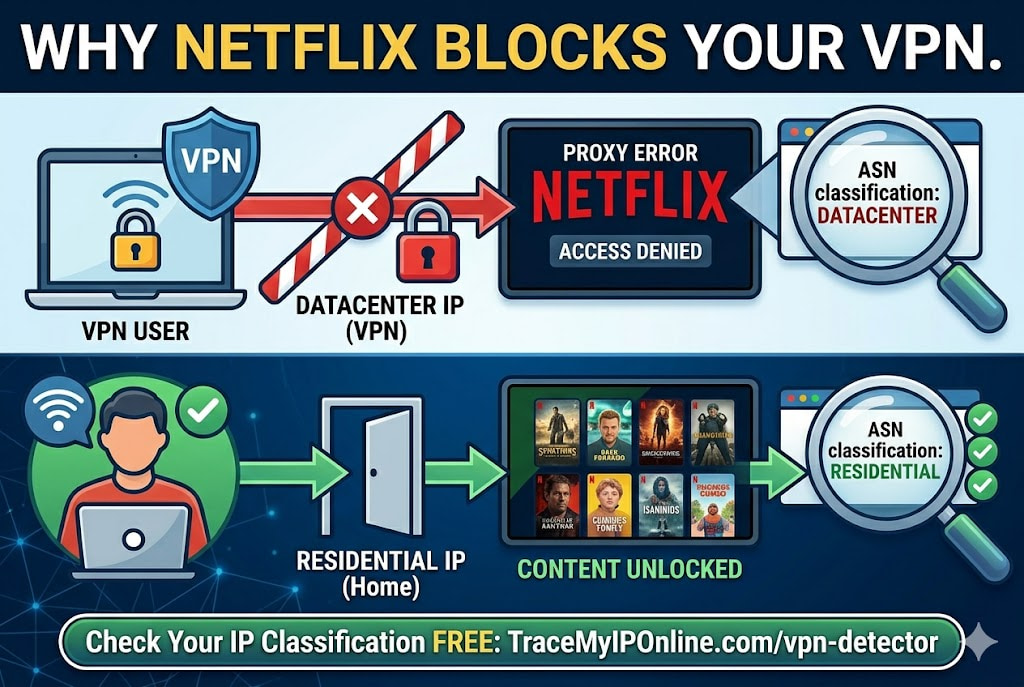
If you have tried watching another country's Netflix library and hit the proxy error, you have experienced IP-based content enforcement. Netflix is not guessing. They are not blocking based on your account location. They are identifying your IP as belonging to a datacenter rather than a residential ISP — and that classification is technically reliable enough to block most VPN traffic. Here is exactly how it works.
Netflix Blocks VPNs — Here Is the Exact Technical Method They Use
If you have tried to watch content from another country's Netflix library and hit the proxy error, you have experienced IP-based content enforcement. Netflix is not guessing. They are not blocking based on your account location. They are identifying your IP address as belonging to a datacenter or known VPN provider rather than a residential internet customer — and that distinction is technically reliable enough to block most VPN traffic.
Understanding how the detection works is useful regardless of whether you care about Netflix specifically. The same mechanism is used by Disney+, BBC iPlayer, Hulu, and most other streaming services. Banks, financial services, and government platforms use similar IP classification for fraud detection.
"The core of streaming VPN detection is ASN classification. VPN providers lease IP ranges from datacenters — AWS, DigitalOcean, Vultr, OVH, M247. These IP ranges are registered to those datacenter operators in the public ARIN and RIPE databases. A residential internet user has an IP from their ISP's residential ASN. A VPN user has an IP from a datacenter ASN. The classification is public data, updated as new IP blocks are registered, and the mismatch is detected automatically."
— Dr. Maya Osei, Internet Protocol Research, Carnegie Mellon University
The Technical Mechanism: ASN-Based Detection
Every IP address belongs to an Autonomous System (AS) — a network operated by a specific organization and registered in public databases. The Autonomous System Number (ASN) identifies which organization controls the IP block.
Netflix and other streaming services maintain databases that classify ASNs into categories: residential ISP, mobile carrier, university, government, corporate, or datacenter/hosting. When you connect, they query which ASN your IP belongs to. If it is a residential ISP ASN — Comcast (AS7922), BT (AS2856), Rogers (AS812) — you look like a normal user. If it is a datacenter ASN — DigitalOcean (AS14061), M247 (AS9009), AWS (AS16509) — you look like a VPN or server connection.
This classification is derived entirely from public data. The ASN registration is in public RIR (Regional Internet Registry) databases. Netflix and other services update their classification databases continuously as new IP ranges are registered and deployed.
Check whether your IP resolves to a datacenter or residential ASN at tracemyiponline.com/ip-lookup. The connection type field shows exactly how your IP is classified.
Why Most VPNs Cannot Beat This Detection
Standard VPN providers buy or lease IP addresses from datacenter providers. They route your traffic through servers hosted at facilities like those run by M247, Choopa, Digital Ocean, or OVH. The IP addresses on these servers are registered to those datacenter operators in the public RIR databases.
Netflix queries those databases. The IP resolves to M247 or Choopa or similar. That is not a residential user. Access denied.
The VPN cannot easily solve this problem by changing their servers — the new servers are also in datacenters with datacenter ASNs. The core issue is architectural, not a matter of finding the right server location.
What Does Bypass Netflix Detection — Residential Proxies and IPs
Some VPN providers and proxy services specifically acquire residential IP addresses — addresses on residential ISP ASNs rather than datacenter ASNs. These are typically peer-to-peer residential proxy networks, where bandwidth from real residential customers is shared (with the customers' consent in the legitimate services, or without it in the illegitimate ones).
An IP from a residential proxy network is classified as a residential ISP IP — because it is one. Netflix sees an IP from Comcast or BT or Telstra and treats it as a normal user. The residential classification is accurate from the database's perspective — the IP does belong to a residential ISP customer.
This approach has trade-offs: residential proxy IPs are more expensive than datacenter IPs, speeds are variable, and some services have begun detecting and blocking known residential proxy ranges as well.
Before vs After: VPN Detection in Practice
Standard VPN scenario — user connects to NordVPN US server: IP: 193.42.104.xxx. ASN: AS210644 (AEZA International Ltd — datacenter). Connection type: Datacenter. Netflix classification: VPN/Proxy detected. Result: Proxy error, access blocked.
Residential proxy scenario — user routes through residential proxy in the US: IP: 68.xxx.xxx.xxx. ASN: AS7922 (Comcast Cable Communications). Connection type: Residential broadband. Netflix classification: Residential US user. Result: Full US content library accessible.
The difference is entirely in the ASN and connection type classification — both verifiable through our VPN Detector and IP Lookup tools.
How This Same Detection Is Used Beyond Streaming
Banking and financial services: Banks use IP classification to detect fraud. A login from a residential ISP in the account holder's usual city looks normal. A login from a datacenter IP in a different country — even if the password is correct — triggers fraud alerts. The ASN classification is a fraud signal independent of geographic location.
E-commerce fraud detection: Payment processors flag transactions from datacenter IPs because legitimate consumers do not shop from servers. A purchase attempt from DigitalOcean infrastructure raises immediate fraud scoring concerns. Check your connection type at tracemyiponline.com/ip-lookup — if you are classified as datacenter while not using a VPN, something on your network may be routing traffic unexpectedly.
Ad fraud detection: Digital advertising platforms filter clicks from datacenter IPs because legitimate ad clicks come from real users on residential or mobile connections, not from servers.
Form submission filtering: Websites receiving form submissions — contact forms, account registrations, survey responses — filter based on IP classification to reduce bot and automated submission traffic.
For California and New York Users: Streaming Access and Terms of Service
Using a VPN to access streaming content from another region likely violates the service's terms of service — Netflix's terms prohibit bypassing geographic restrictions — but it is not illegal in the US, UK, Canada, or Australia. The legal landscape occasionally changes, but terms of service violations result in account suspension risk, not criminal liability.
For California and New York users using VPNs for privacy rather than streaming access: the same detection mechanism that blocks Netflix does not affect your privacy use. ISP-level privacy is maintained regardless of whether streaming services can detect your VPN — the VPN still encrypts your traffic from your ISP's view. Verify your VPN is working for privacy purposes at tracemyiponline.com/vpn-detector.
For London and UK Users: BBC iPlayer and UK IP Verification
BBC iPlayer requires a UK IP address and a valid TV licence for access. The detection mechanism is identical to Netflix's — iPlayer checks whether the connecting IP belongs to a UK residential ISP ASN. Standard datacenter VPN IPs are blocked. UK residents who lose access while on VPN can simply disconnect the VPN for iPlayer, since their real residential UK IP is exactly what iPlayer wants.
For UK users outside the UK who want iPlayer access while traveling: residential UK proxy services can provide a UK residential IP. The same technical principle applies as for Netflix. Verify your current IP classification at tracemyiponline.com/vpn-detector.
For Toronto and Ontario Users: Content Licensing and Canadian IP
Canadian streaming content libraries differ from US libraries due to different content licensing agreements. Crave, CBC Gem, and Canadian Netflix all have Canadian-specific content accessible to Canadian IP addresses. Canadian users traveling internationally may lose access to Canadian-licensed content — and this is enforced through the same IP classification mechanism.
For Ontario users: a Canadian residential VPN connection maintains access to Canadian-licensed content while traveling. The VPN needs to have a Canadian residential IP (not just a datacenter IP in Canada) to bypass the streaming service's detection. Check IP classification at tracemyiponline.com/vpn-detector.
For Sydney and Australian Users: Stan, Foxtel Now, and Australian IP
Australian streaming services — Stan, Foxtel Now, 9Now — enforce Australian-only access through IP classification. Australian content rights are licensed separately from international versions, so access is restricted to Australian residential IPs. The same ASN-based detection used by Netflix applies.
For Sydney and Melbourne users: connecting to Australian-licensed streaming from overseas requires an Australian residential IP. Standard VPN server IPs in Australia will be datacenter-classified and blocked. Check your current IP's classification at tracemyiponline.com/vpn-detector.
What VPN Providers Are Doing About Detection
VPN providers are in an ongoing arms race with streaming services. Current approaches:
Obfuscated servers: Servers that disguise VPN traffic as regular HTTPS traffic. This helps bypass deep packet inspection blocks but does not help with IP classification — the IP still belongs to a datacenter ASN.
Dedicated IP addresses: Some providers offer dedicated IPs used by only one customer. Less likely to be on shared blocklists but still typically datacenter-classified.
Smart DNS: Routes only the initial domain lookup through a proxy, leaving the actual streaming traffic unrerouted. The IP connecting to Netflix is the user's real IP — so no VPN detection. However, this provides no privacy protection.
Residential IP options: A small number of premium providers now offer access to residential IP pools as an add-on. More expensive and slower but genuinely bypasses ASN-based detection.
Frequently Asked Questions
Is the VPN Detector tool free?
Yes — 100% free, no signup. Visit tracemyiponline.com/vpn-detector and see your IP's current classification instantly.
My VPN says it works with Netflix — why does it still get blocked?
VPN providers update their server IPs periodically, and streaming services update their block lists frequently. A server that worked last week may be blocked this week. Try different server locations within the same country. Servers labeled "optimized for streaming" are often updated more frequently. Check whether your current VPN IP is datacenter-classified at tracemyiponline.com/vpn-detector.
Does using a VPN affect my connection speed for streaming?
Yes — a VPN adds latency and reduces throughput. For streaming, the relevant metric is download speed. A nearby VPN server with a good connection should reduce your speed by 10-20%. A heavily loaded or geographically distant server can reduce it much more. Test at tracemyiponline.com/speed-test with VPN on and off to measure your specific situation.
Why does Netflix show a proxy error when I am not using a VPN?
Your IP might be on a shared VPN block list from previous users (if you have a dynamic IP that was previously used by a VPN service), or your ISP routes traffic through infrastructure that shares ASN space with a flagged provider. Check your IP's full classification at tracemyiponline.com/ip-lookup and tracemyiponline.com/vpn-detector. Contact your ISP if the classification appears incorrect — they can sometimes request ASN database corrections.
Can streaming services ban my Netflix account for using a VPN?
Netflix's terms of service prohibit circumventing geographic restrictions, and they could theoretically suspend accounts for it. In practice, Netflix typically shows the proxy error and blocks access rather than suspending accounts — the block is the enforcement mechanism. The risk of account suspension for casual VPN use is low but not zero.
The Detection Is the Same Everywhere — Understanding It Matters
Netflix's VPN blocking is the most visible application of ASN-based IP classification, but the same mechanism affects banking fraud detection, payment processing, ad fraud filtering, and access control across the internet.
Whether you care about streaming access or not, knowing how your IP is classified — residential or datacenter, clean reputation or flagged — is practically useful for troubleshooting access issues, verifying VPN behavior, and understanding why specific services behave differently with your connection.
Check your IP's full classification at tracemyiponline.com/ip-lookup. Test VPN detection at tracemyiponline.com/vpn-detector. Verify DNS configuration at tracemyiponline.com/dns-lookup. All free at TraceMyIPOnline.com.