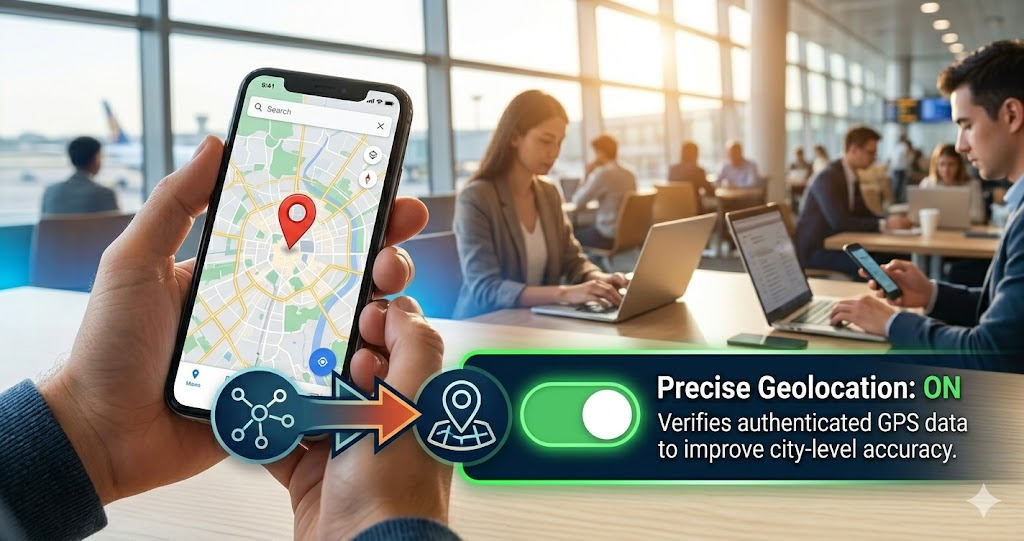
IP geolocation accuracy statistics get quoted a lot without context. 99% country-level accuracy sounds impressive until you realize country-level is not what anyone actually cares about. City-level accuracy — at 60-80% in ideal conditions, less in rural areas — is where practical limitations appear. Understanding what the numbers mean changes how you use geolocation data and why your IP sometimes shows the wrong city.
IP Geolocation Is 99% Accurate at Country Level and 60% Accurate at City Level — Here Is What That Actually Means
IP geolocation accuracy statistics get quoted a lot without context. "99% country-level accuracy" sounds impressive until you realize that country-level accuracy is not what anyone actually cares about — knowing a user is in the United States is not that useful when you want to know if they are in Seattle or Miami. City-level accuracy, at 60-80% in best conditions and lower in rural areas, is where the practical limitations of IP geolocation show up.
Understanding what the accuracy figures mean — and where they fail — matters for developers building location-based features, for businesses using IP geolocation for compliance, and for users wondering why their IP lookup shows the wrong city.
Check your own IP's geolocation data at tracemyiponline.com/ip-lookup — free, no signup.
"The 99% country-level accuracy figure is essentially a floor — it is accurate enough that it is not very interesting as a measurement. What matters commercially is accuracy at the city level, and that is where significant variance exists. In dense urban environments with rich ISP registration data, city-level accuracy can exceed 90%. In rural areas with sparse infrastructure and less detailed ISP registration, it can fall below 50%. The databases update continuously, but they can never be more accurate than the underlying ISP registration data, which is not always precise."
— Dr. Isabel Carvalho, Geolocation Systems Research, Universidade de Lisboa
How IP Geolocation Databases Work — The Data Sources
Commercial IP geolocation databases — MaxMind, DB-IP, IPinfo, and others — combine multiple data sources to map IP address ranges to geographic locations:
Regional Internet Registry (RIR) data: ARIN, RIPE NCC, APNIC, LACNIC, and AFRINIC publish records of which organizations were allocated which IP blocks. These records include the country of the allocating organization, and sometimes the city. This is publicly available and reasonably accurate at country level.
ISP registration data: ISPs submit more granular geographic information for their IP ranges during registration. A cable ISP might register their Chicago-area customer pool with city-level detail. This improves accuracy in areas where ISPs maintain detailed registration data.
Network latency measurements: By measuring round-trip times from known geographic reference points to target IPs, databases can estimate distance and narrow location.
Active probing and user-contributed data: Some databases use GPS data from mobile devices (with consent) and voluntarily submitted location corrections. This is effective in high-population areas and poor in rural regions.
Where IP Geolocation Fails — Specific Scenarios
ISP hub routing: The most common cause of city-level inaccuracy. Your ISP routes all regional traffic through a hub city, and your IP block is registered to that hub rather than your actual city. Comcast users in suburban Chicago might geolocate to the city center. BT users in rural England might geolocate to Birmingham or Reading.
Mobile carrier routing: Mobile networks aggregate traffic at carrier facilities that may be far from the subscriber. A Telstra user in regional Queensland might geolocate to Brisbane. Mobile IP geolocation is generally less precise than broadband geolocation.
Corporate VPN routing: Traffic routed through a corporate VPN exits from the company's headquarters IP. A remote employee in Boston connected to a New York corporate VPN appears to be in New York.
CG-NAT: Multiple users sharing a single public IP through Carrier Grade NAT. The shared IP geolocates to wherever the NAT device is — which may serve a wide geographic area.
Database lag: ISPs periodically reassign IP blocks between regions. Geolocation databases update periodically, not in real time. An IP block that moved from one city to another may geolocate to the old location for weeks or months.
Before vs After: Testing IP Geolocation Accuracy Across Connection Types
Home broadband (cable, suburban US): Actual location: Naperville, Illinois. IP geolocation result: Chicago, Illinois. Accuracy: City incorrect (ISP hub routing), metro correct, state correct, country correct. Typical for suburban cable users — the ISP hub city appears rather than the actual suburb.
Mobile data (same user, T-Mobile): Actual location: Naperville, Illinois. IP geolocation result: Kansas City, Missouri. Accuracy: City and state both wrong — T-Mobile routes this area through a Missouri hub. Country correct. This is expected mobile carrier behavior.
Corporate VPN (Chicago HQ): Actual location: Naperville, Illinois. IP geolocation result: Chicago, Illinois. Accuracy: Shows the VPN exit point, not actual location. City happens to be correct but for the wrong reason.
Check your own connection's accuracy at tracemyiponline.com/ip-lookup and compare to your actual location.
Why IP Geolocation Accuracy Matters for Developers
Currency and pricing: Country-level geolocation for currency selection is reliable. City-level for local pricing is not sufficiently accurate to be the sole signal — supplement with user preference and explicit input.
Content geo-restriction compliance: Country-level blocking is reasonably reliable. State-level content restrictions using IP geolocation will have meaningful false positive and false negative rates due to hub routing. Legal compliance should not rely solely on IP geolocation for sub-national jurisdiction determination.
Fraud detection: IP geolocation as a fraud signal works best at detecting gross mismatches (billing address in California, IP in Eastern Europe) rather than local anomalies. Treat it as one signal among many.
For California and New York Developers: Geolocation Accuracy and Legal Compliance
California's CCPA and various sector-specific regulations create requirements around geographic jurisdiction determination. If your application makes legal determinations based on IP geolocation — whether a user is a California resident for CCPA purposes — the 60-80% city-level accuracy figure has direct compliance implications.
For California and New York applications: IP geolocation can be a starting point for jurisdiction determination but should be supplemented with user self-identification for legal compliance purposes. Check accuracy with our IP Lookup.
For London and UK Developers: Geolocation and UK GDPR
UK GDPR jurisdiction applies to processing of UK residents' data regardless of where the controller is located. IP geolocation to determine whether a user is a UK resident has the same accuracy limitations — hub routing and mobile carrier routing mean a user actually in the UK might geolocate to Ireland or continental Europe temporarily.
For UK developers: do not rely solely on IP geolocation to determine GDPR applicability. The safer approach is to assume GDPR applies to any user who could plausibly be in the UK. Check your own IP's geolocation accuracy at tracemyiponline.com/ip-lookup.
For Toronto and Ontario Developers: Geolocation and PIPEDA
Canadian privacy law applies to personal information collected from Canadian residents regardless of whether IP geolocation correctly identifies them as Canadian. A user physically in Ontario but whose mobile IP geolocates to the US is still a Canadian resident for PIPEDA purposes.
Ontario-based developers building applications that make PIPEDA compliance determinations should supplement the geolocation signal with other indicators and apply PIPEDA requirements conservatively when jurisdiction is ambiguous.
For Sydney and Australian Developers: Geolocation and Privacy Act
Australia's Privacy Act applies to Australian residents' personal information regardless of IP geolocation accuracy. An Australian resident whose Telstra mobile IP geolocates to New Zealand is still an Australian resident under the Privacy Act. Apply the Privacy Act conservatively to users who might be Australian rather than trying to precisely exclude them based on potentially inaccurate IP geolocation.
Frequently Asked Questions
Is the IP Lookup tool free?
Yes — 100% free, no signup. Visit tracemyiponline.com/ip-lookup and check any IP's geolocation data instantly.
Why does my IP show the wrong city even though I have a fixed address?
Your IP block is registered to your ISP's infrastructure location, not your physical address. ISPs manage large blocks of IPs across wide geographic areas, and the registration may point to a hub city rather than your specific location. This is normal and has nothing to do with your router or connection quality.
Is GPS more accurate than IP geolocation?
Dramatically so — GPS accuracy is typically within meters when a device has signal. IP geolocation accuracy at best reaches city block level in ideal conditions and can be off by hundreds of kilometers. They are not comparable systems.
Can I report an inaccurate IP geolocation?
Yes — most commercial geolocation providers have correction submission forms. MaxMind, DB-IP, and IPinfo all accept location corrections. Corrections take days to weeks to propagate.
Does my IP ever geolocate accurately to my exact street address?
No. Street-level accuracy from IP geolocation is not achievable — IP blocks are registered at organizational level (the ISP), not at individual subscriber level. Your street address is known only to your ISP and is linked to your IP only through internal ISP records, not through any public geolocation database.
What the Numbers Actually Mean — And How to Use Them
99% country-level accuracy is useful for content localization and currency selection. 60-80% city-level accuracy is useful as one signal among several for fraud detection. It is not useful as the sole basis for legal jurisdiction determination or as a precise location for mapping.
Check your IP's current geolocation at tracemyiponline.com/ip-lookup. Verify DNS records at tracemyiponline.com/dns-lookup. Check domain age at tracemyiponline.com/whois-lookup. All free at TraceMyIPOnline.com.