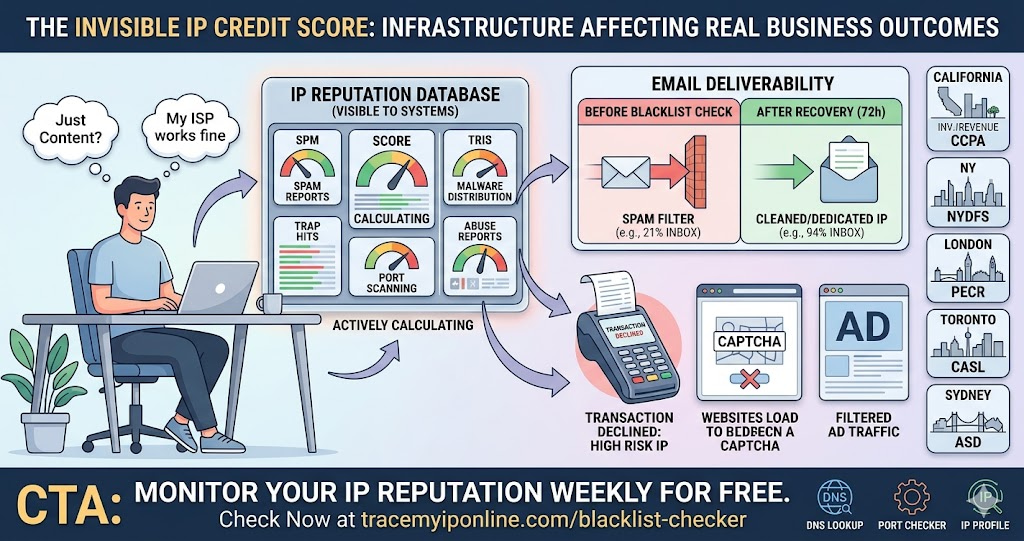
Across the internet, databases score IP addresses the same way credit bureaus score borrowers. These scores influence whether your emails reach inboxes, whether payment platforms accept transactions, and whether websites serve you normally or flag you for additional verification. Unlike credit scores, you were never told these scores exist. The score was built from traffic patterns, spam reports, and the behavior of whoever used your IP before you.
Your IP Address Has a Credit Score — You Just Cannot See It By Default
Across the internet, databases score IP addresses the same way credit bureaus score borrowers. These scores influence whether your emails reach inboxes, whether payment platforms accept your transactions, whether websites serve you content or block you, and in some cases whether you can access services at all.
Unlike credit scores, you were never told these scores exist. Nobody sent you a letter explaining your IP's reputation. The score was built from traffic patterns, spam reports, abuse complaints, and the behavior of whoever used that IP address before you — and it affects you whether you know about it or not.
Check your IP's current reputation free at tracemyiponline.com/blacklist-checker — no signup needed.
"IP reputation scoring has become more sophisticated and more consequential than most people realize. In the early days, it was just spam blacklists. Now major email providers, payment processors, ad networks, and security platforms all maintain proprietary IP scoring systems. A residential IP with a poor reputation score from previous user behavior can affect email deliverability, cause payment declines, and trigger enhanced fraud screening — all invisibly, all without the current IP holder having any idea it is happening."
— Dr. Sofia Eriksson, Network Reputation Systems Research, Stockholm University
What IP Reputation Scoring Actually Measures
IP reputation scores are built from several data sources, continuously updated:
Spam reports: When recipients click "report spam" on an email, the sending IP is logged. Enough spam reports against an IP triggers blacklisting. The threshold varies by blacklist and by how quickly reports accumulate.
Trap hits: Spam traps are email addresses maintained by blacklist operators specifically to catch spam. They are never used for legitimate signups. An IP that sends to a spam trap has either been scraping email addresses or using unverified lists — automatic blacklisting follows.
Malware distribution: IPs that serve malware, host phishing pages, or distribute exploit kits are flagged by security vendors and added to threat intelligence feeds. These flags affect access to security-conscious services well beyond email.
Port scanning and attack behavior: Automated scanners track which IPs probe other systems for vulnerabilities. An IP that scans large ranges of ports gets flagged as potentially automated or malicious.
Abuse reports: ISP abuse teams and security researchers file reports about IPs engaged in problematic behavior. These reports feed into reputation databases used by downstream services.
Historical behavior: Reputation databases have long memories. Some blacklist entries persist for months after the problematic activity stops. A residential IP that was used by a spam operation years ago may still carry degraded reputation score data.
How IP Reputation Affects You in Practice
Email delivery: The most direct and measurable impact. Gmail, Outlook, and Yahoo all weight IP reputation heavily in spam filter decisions. A poor-reputation sending IP sees significantly lower inbox placement rates — sometimes dramatically lower, as the before/after example below shows.
Payment processing: Payment processors and fraud detection systems factor IP reputation into transaction risk scoring. A purchase attempt from a flagged IP may require additional verification, be declined automatically, or be routed to manual review — even when the transaction itself is legitimate.
Ad serving: Digital advertising platforms check IP reputation to detect fraud. Clicks from flagged IPs may be filtered from advertiser billing, or flagged IPs may receive reduced ad inventory or different ad treatments.
Website access: Some websites, particularly those in financial services, healthcare, and e-commerce, use IP reputation as an access control signal. A heavily flagged IP might see CAPTCHAs, additional authentication steps, or in some cases access denial.
Security platform scoring: Threat intelligence platforms like VirusTotal, AbuseIPDB, and Shodan's data aggregations maintain public reputation scores that security professionals consult when investigating suspicious traffic.
Before vs After: IP Reputation Recovery
Small business email campaign — 5,000 subscribers, IP newly on Spamhaus SBL: Sent: 5,000. Gmail inboxed: 580 (23% of Gmail recipients). Outlook inboxed: 290 (18% of Outlook recipients). Overall inbox rate: approximately 21%. Revenue from campaign: $1,800.
The business owner had no idea the IP was blacklisted. They assumed the content was the problem. They rewrote the email three times. The problem was not the content.
Blacklist check at tracemyiponline.com/blacklist-checker — IP on Spamhaus SBL. Root cause: shared hosting, a previous tenant on the IP had run a pharmaceutical spam campaign 14 months earlier. IP had never been cleaned from the Spamhaus database.
After delisting (72 hours) and moving to dedicated IP with clean history: Sent: 5,000. Gmail inboxed: 2,300 (92% of Gmail recipients). Outlook inboxed: 1,540 (96% of Outlook recipients). Overall inbox rate: approximately 94%. Revenue from same campaign: $8,700.
Same list. Same content. Same business. The IP was the entire problem.
For California and New York Businesses: IP Reputation and Revenue
California-based technology, e-commerce, and media companies rely on email more than almost any other sector. A blacklisted IP silently destroys email marketing ROI — the emails appear to send successfully, no bounce notifications arrive, but inbox placement falls dramatically and revenue follows.
Under California's CCPA, businesses can request deletion of IP-linked data from certain types of data processors. But blacklist operators are not CCPA-covered entities in the traditional sense, and blacklist removal is handled through technical delisting processes rather than legal ones. Regular monitoring at tracemyiponline.com/blacklist-checker is the practical approach.
New York's financial sector — banks, insurance companies, investment firms — uses IP reputation extensively in fraud detection. A New York business whose corporate IP has accumulated negative reputation signals may experience payment processing friction, increased fraud alerts, and client-facing service disruptions. Monthly IP reputation checks prevent these issues from becoming serious.
For London and UK Businesses: IP Reputation and Email Compliance
UK businesses subject to PECR (Privacy and Electronic Communications Regulations) and UK GDPR for email marketing face a dual compliance challenge: the legal requirements around consent and content, and the technical requirement for good IP reputation. Both are necessary for email marketing to work. Neither substitutes for the other.
BT, Sky, and Virgin Media residential IPs are subject to the same inherited reputation risks as any other ISP's dynamic IP pool. London businesses sending from shared hosting or consumer-grade ISP connections should check IP reputation regularly. The ICO does not handle IP reputation complaints — these are technical matters handled through blacklist operators. Check at tracemyiponline.com/blacklist-checker.
For Toronto and Ontario Businesses: CASL Compliance and IP Reputation
CASL compliance addresses whether you are allowed to send email. IP reputation addresses whether the email arrives. A 100% CASL-compliant campaign from a blacklisted IP still does not reach inboxes. Both problems need to be solved independently.
Ontario-based businesses frequently discover IP reputation problems when investigating unexplained drops in email engagement metrics — open rates, click rates, revenue attribution. The discovery typically comes months after the reputation problem begins. Monthly monitoring at tracemyiponline.com/blacklist-checker catches problems before they become catastrophic.
For Sydney and Australian Businesses: Email Infrastructure and the Spam Act
Australia's Spam Act requires consent, identification, and unsubscribe mechanisms for commercial email. Meeting these requirements does not guarantee delivery — IP reputation operates entirely outside the Spam Act's scope. The ACMA enforces the Spam Act; no regulatory body handles IP reputation.
Australian businesses using self-hosted or VPS email infrastructure should treat IP reputation monitoring as standard operating procedure. Telstra and Optus residential IPs are subject to the same CG-NAT and IP recycling dynamics as other major ISPs — inherited reputation from previous users is a real risk. Check at tracemyiponline.com/blacklist-checker.
How to Actively Manage Your IP Reputation
Monitor regularly: Weekly for high-volume email senders. Monthly for lower-volume or residential users. Immediately if you notice deliverability problems, access issues, or unusual service friction. The check at tracemyiponline.com/blacklist-checker takes 30 seconds.
Use dedicated IPs for business email: Shared hosting IPs carry the reputation risks of all co-hosted domains. A dedicated IP for email sending means your reputation is entirely determined by your own traffic — no inherited problems from hosting neighbors.
Maintain clean email lists: Remove hard bounces immediately. Use double opt-in for new subscribers. Remove inactive subscribers after 6-12 months. High bounce rates and spam complaint rates degrade IP reputation faster than almost anything else.
Configure email authentication properly: Correct SPF, DKIM, and DMARC records do not improve a blacklisted IP's reputation directly, but they prevent easy spoofing of your domain and improve overall deliverability signals. Check your domain's authentication at tracemyiponline.com/dns-lookup.
Close unnecessary open ports: IP reputation is affected by network behavior, not just email. An open port being exploited for scanning or spam relay degrades your IP's reputation even if you personally do nothing wrong. Check at tracemyiponline.com/port-checker.
Frequently Asked Questions
Is the IP reputation / blacklist check free?
Yes — 100% free, no signup, unlimited checks. Visit tracemyiponline.com/blacklist-checker and check any IP's status instantly.
How long does a blacklist entry stay on my IP?
It depends on the blacklist. SpamCop entries auto-expire within 24-48 hours when the problematic traffic stops. Spamhaus SBL entries persist until a successful removal request is submitted — typically 24-72 hours after requesting. Barracuda typically removes within 12-24 hours. Some niche blacklists have less clear processes.
My IP is clean on your checker but emails still land in spam — why?
IP reputation is one factor in spam filtering. Domain reputation is separate — your domain can accumulate negative reputation from past sending behavior, high bounce rates, or spam complaints even if the sending IP is clean. Missing authentication records (SPF, DKIM, DMARC) also cause spam placement. Check your domain's authentication at tracemyiponline.com/dns-lookup.
Can a VPN IP have poor reputation?
Yes — often worse than a typical residential IP. VPN datacenter IPs are shared among many users, including some who use them for spam, scanning, or automated activity. Many VPN IP ranges appear on consumer blacklists and are filtered by services that block VPN access. If you need to send email or conduct transactions that are reputation-sensitive, avoid VPN IPs for those specific activities.
What is the difference between IP reputation and domain reputation?
IP reputation relates to the network address sending the traffic. Domain reputation relates to the domain name in the From address and links. Both matter for email deliverability, and they are maintained separately by different systems. A clean IP can send email from a domain with poor reputation and still land in spam. Both need to be healthy.
Should I report my IP if I find it on a blacklist?
Check the blacklist operator's website for their reporting process. Most have removal request forms. Report the listing, investigate the root cause, fix it, then request removal. Most blacklist operators will not remove an IP that is still actively sending problematic traffic — fix first, request second.
The Invisible Infrastructure That Affects Real Business Outcomes
IP reputation is background infrastructure — invisible, automatic, and consequential. It affects email campaigns, payment processing, service access, and security screening without any obvious indication that the underlying cause is an IP reputation problem rather than something else.
Thirty seconds of monitoring per week prevents the scenarios where a months-long deliverability problem is finally diagnosed — after multiple failed content rewrites and expensive deliverability audits — as a blacklist listing that would have taken 48 hours to resolve if caught early.
Check your IP now at tracemyiponline.com/blacklist-checker. Verify email authentication at tracemyiponline.com/dns-lookup. Check open ports at tracemyiponline.com/port-checker. All free at TraceMyIPOnline.com.