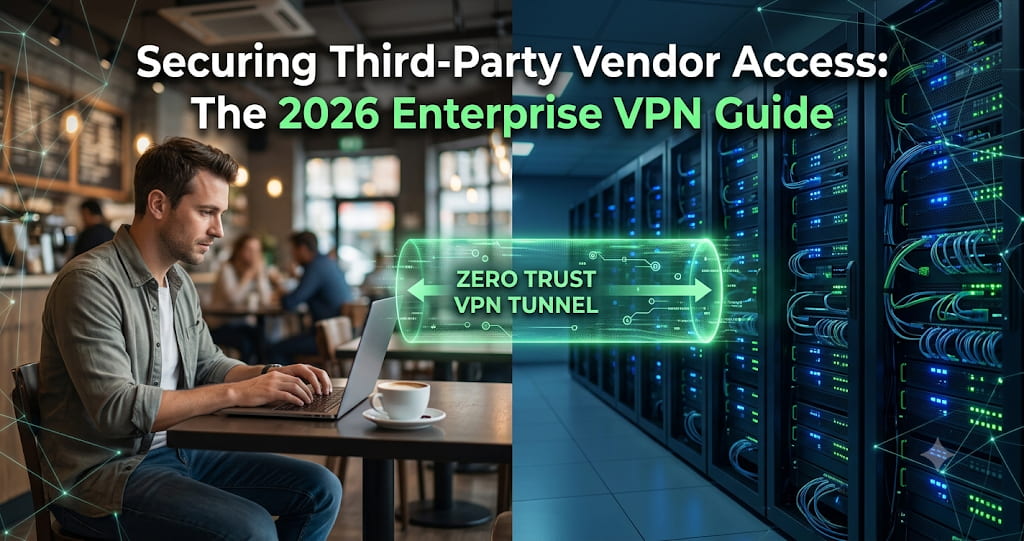
Your internal security might be flawless, but what about your external contractors? In 2026, 73% of major corporate data breaches originate from compromised third-party vendor access. Discover how replacing shared passwords with identity-driven Enterprise VPNs and strict IP intelligence can lock down your supply chain and prevent devastating lateral breaches.
Modern enterprises do not operate in isolation. You rely on external marketing agencies, offshore development teams, freelance consultants, and third-party billing providers. But while organizations spend millions securing their internal employees, they frequently hand over the keys to the kingdom by giving contractors unmonitored access to the corporate network via legacy VPNs. In 2026, supply chain attacks are the weapon of choice for cybercriminals. According to recent B2B cybersecurity audits, a staggering 73% of severe corporate data breaches originated from a compromised third-party vendor account.
If your organization is giving contractors broad network access without strictly auditing their login origins using an IP address lookup tool, you are completely blind to insider threats and credential stuffing attacks. The 2026 mandate for Third-Party Risk Management (TPRM) requires replacing implicit trust with Zero Trust Network Access (ZTNA) and dedicated enterprise VPN gateways specifically segmented for contractors.
"A contractor's laptop is the ultimate Trojan Horse. If you allow a third-party vendor to access your network via a standard VPN without continuous IP verification and device posture checks, their malware becomes your malware in seconds." — Lead Cybersecurity Architect, TraceMyIPOnline.
The Danger of Shared Vendor Logins
The most common and dangerous practice in vendor management is the "shared agency login." A company hires an external marketing firm and provides a single VPN credential: marketing_vendor_vpn. That single password is then shared among twenty different freelancers at the agency.
When a breach occurs, the corporate IT team sees the malicious activity coming from the marketing_vendor_vpn account, but they have absolutely no forensic ability to determine which human being was actually on the keyboard. By deploying a modern Enterprise VPN or ZTNA platform, access is tied to individual human identities and their specific hardware, not just a shared password. The VPN continuously logs the unique IP address of every single contractor, instantly flagging impossible travel or logins from high-risk foreign Autonomous System Numbers (ASNs).
Before vs. After: Third-Party Access Management
Security Scenario | Legacy VPN (Unmanaged Contractor) | Enterprise ZTNA VPN (Managed Access)Account Sharing | Common. Multiple contractors use one login. | Blocked. Access tied to individual device biometric/MFA.
Network Visibility | Contractor sees the entire internal corporate LAN. | Contractor only sees the single app they are assigned to.
Compromised Laptop | Vendor's malware spreads laterally to your servers. | Device posture check fails; VPN connection instantly denied.
Offboarding | IT forgets to revoke the shared password; access remains. | Automated provisioning revokes the contractor's specific ID.
Network Visibility | Contractor sees the entire internal corporate LAN. | Contractor only sees the single app they are assigned to.
Compromised Laptop | Vendor's malware spreads laterally to your servers. | Device posture check fails; VPN connection instantly denied.
Offboarding | IT forgets to revoke the shared password; access remains. | Automated provisioning revokes the contractor's specific ID.
Programmatic Security: Geo-Targeted Vendor Controls (H2s)
Different industries utilize third-party labor differently. Here is how major corporate hubs are locking down contractor access using advanced enterprise VPN architectures in 2026.
Offshore Development: Austin Tech Sector
Austin's software companies rely heavily on offshore development teams in Eastern Europe and South America. Giving these developers traditional VPN access to the core AWS environment is a massive risk. Instead, Austin firms use Cloud SASE platforms to create isolated contractor zones. Developers must connect through the enterprise VPN, which verifies their international IP address against a pre-approved geographical whitelist. If an offshore developer's credentials are stolen and used by a local Austin IP, the system flags the geographical anomaly and blocks access.
External Legal Counsel: New York Corporate Firms
When New York financial corporations engage external law firms for mergers or litigation, those lawyers need temporary access to highly confidential data rooms. A data leak here could trigger SEC violations. NYC firms deploy strict Zero Trust VPNs that grant external counsel access only to the specific case files they are authorized to view. The VPN logs every document accessed. If a leak is suspected, investigators might cross-reference internal logs and even find the IP address of a Discord user if they suspect a paralegal is communicating with unauthorized journalists.
Remote Virtual Assistants: Miami Real Estate
Miami's high-end real estate brokerages frequently employ remote virtual assistants (VAs) in the Philippines to manage CRM data and client emails. To prevent client data theft, brokerages issue dedicated VPN profiles to these VAs. The corporate firewall is configured to only accept CRM logins from the specific static IP provided by the enterprise VPN. If a phishing attack tricks a VA, the attackers might try to log in from a different IP, but the firewall drops the connection. Security teams can further investigate the phishing source by using tools to find the IP address from an Instagram message if social media was the attack vector.
Medical Billing Contractors: Dallas Healthcare
Dallas hospital networks outsource their medical billing to specialized third-party agencies. Under HIPAA regulations, the hospital is ultimately responsible if the billing agency causes a data breach. Dallas IT directors require billing contractors to connect via enterprise VPNs with mandatory, non-bypassable logging. To ensure these intense logging requirements do not slow down the billing software, IT teams regularly review Enterprise VPN Performance Benchmarks to optimize the encrypted tunnels. For a deeper dive on regulatory requirements, review our guide on Why Enterprise VPN Logs Are Mandatory for Compliance.
Top Enterprise VPNs for Vendor Risk Management (Competitor Table)
If you need to secure third-party access, look for VPN providers that offer "Clientless ZTNA" (allowing contractors to access apps via a secure browser without installing a VPN client) and strict granular access controls.
Security Vendor | Vendor Management Feature | Deployment Model | Ideal For (2026)Zscaler Private Access | Clientless Browser Access | Cloud-Native ZTNA | Large Enterprises with thousands of contractors.
Perimeter 81 | Easy Contractor Segmentation | Cloud VPN / ZTNA | Mid-Market SaaS & B2B Agencies.
Cisco Secure Access | Deep Device Posture Checks | Hybrid Architecture | Highly regulated industries (Healthcare/Finance).
NordLayer (B2B) | Fast Partner Provisioning | Cloud VPN | SMEs scaling their freelance workforce.
TraceMyIPOnline | Pre-Authentication IP Auditing | Web Diagnostic | Verifying vendor IPs before granting VPN access.
Perimeter 81 | Easy Contractor Segmentation | Cloud VPN / ZTNA | Mid-Market SaaS & B2B Agencies.
Cisco Secure Access | Deep Device Posture Checks | Hybrid Architecture | Highly regulated industries (Healthcare/Finance).
NordLayer (B2B) | Fast Partner Provisioning | Cloud VPN | SMEs scaling their freelance workforce.
TraceMyIPOnline | Pre-Authentication IP Auditing | Web Diagnostic | Verifying vendor IPs before granting VPN access.
2026 Supply Chain Cybersecurity Statistics
- The Main Vector: 65% of organizations admit they have not comprehensively identified all the third parties that have access to their most sensitive data.
- Cost of a Supply Chain Breach: Breaches caused by third-party contractors cost an average of $300,000 more to remediate than internal employee breaches due to the complexity of the forensic investigation.
- ZTNA Mandates: 55% of enterprise vendor contracts in 2026 now legally require the vendor to connect to the client's network exclusively through an approved ZTNA platform.
Frequently Asked Questions (FAQ)
1. Why is a standard VPN dangerous for third-party contractors?
A standard VPN places the contractor directly onto your internal network. If the contractor's device is infected with malware (like ransomware), that malware can easily scan your network and spread to your corporate servers.
2. What is Clientless ZTNA?
Clientless ZTNA allows contractors to securely access specific corporate web applications through a standard web browser, without needing to install a heavy VPN software client on their personal or agency-owned laptops.
3. How do we stop contractors from sharing passwords?
Enterprise VPNs stop password sharing by enforcing Multi-Factor Authentication (MFA) tied to a specific mobile device, and by monitoring geo-velocity. If a login occurs from London, and ten minutes later the same login occurs from India, the VPN instantly blocks the account for impossible travel.
4. Should contractors use their own VPN or ours?
For accessing your corporate resources, they must use your enterprise VPN or ZTNA solution. You cannot trust an external agency's consumer VPN, as it provides you with zero visibility, logging, or access control.
5. How does IP whitelisting work with third-party vendors?
You can require the third-party agency to purchase a static IP address. You then configure your enterprise VPN or firewall to only accept connections from that specific, whitelisted agency IP, blocking all other traffic.
6. How do we audit what a contractor did on our network?
By using an enterprise-grade solution, every action is logged. You can review the SIEM logs to see exactly which IP connected, at what time, and which specific internal applications or files were accessed during that session.
7. Can we restrict vendor access to specific hours?
Yes. Modern enterprise VPN platforms allow you to set time-based access controls. For example, a weekend IT contractor's VPN profile will only authenticate between Saturday 8:00 AM and Sunday 5:00 PM.
8. What is the first step to securing vendor access?
The first step is a comprehensive audit. Identify every third party with access, terminate unused accounts, and immediately use tools like TraceMyIPOnline to review the historical IP access logs of your current vendors to spot any immediate anomalies or unauthorized foreign access.
Contact Us: admin@tracemyiponline.com | Website: https://www.tracemyiponline.com