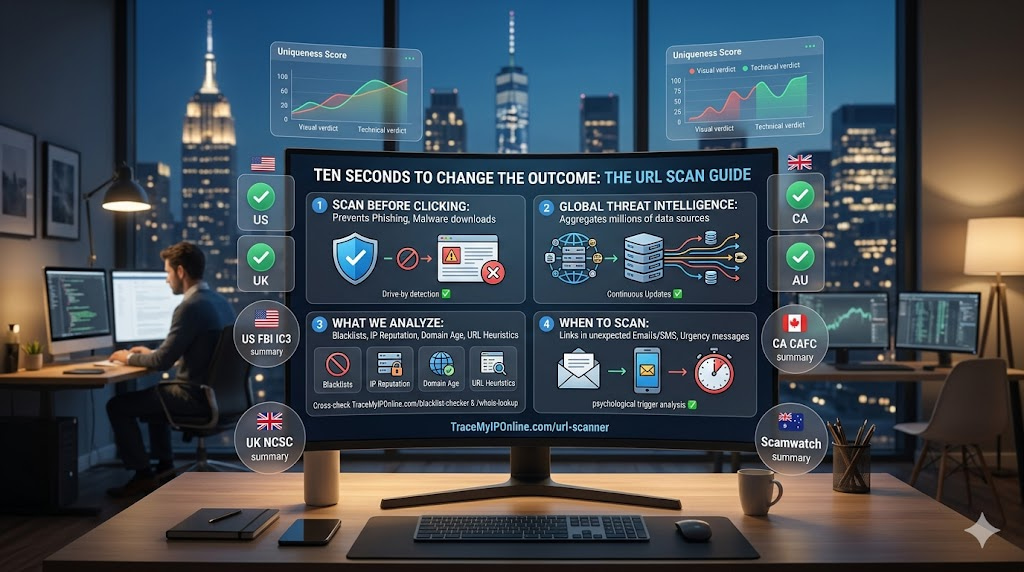
A URL scanner checks a web address against threat intelligence databases before your browser touches it. The check happens entirely on our end — your browser does not contact the destination site at all. You get a verdict in seconds: clean, suspicious, or flagged. The damage from clicking a malicious link often happens immediately on page load. Scanning before clicking breaks this chain.
Before You Click Any Suspicious Link, This Free Check Takes 10 Seconds
A URL scanner checks a web address against threat intelligence databases before your browser touches it. The check happens entirely on our end — your browser does not contact the destination site at all. You get a verdict in seconds: clean, suspicious, or flagged across multiple databases.
The damage from clicking a malicious link often happens immediately on page load. Drive-by malware downloads, credential harvesting forms that look identical to login pages — none of these require you to do anything beyond loading the page. Scanning before clicking breaks this chain.
"URL scanning is one of the highest-ROI security habits available to everyday users. The intelligence databases behind URL scanners aggregate threat data from millions of sources globally — security vendors, ISPs, honeypots, user reports — and are updated continuously. A URL that appeared legitimate 48 hours ago may be flagged today. Scanning immediately before clicking, rather than relying on earlier clean checks, is the correct approach because phishing infrastructure can be activated on very short notice."
— Dr. Sanjay Krishnamurthy, Cyber Threat Intelligence Research, National University of Singapore
What URL Scanners Actually Check
Blacklist databases: Google Safe Browsing, PhishTank, OpenPhish, URLhaus, and others maintain continuously updated lists of known malicious URLs. Any URL appearing on these lists triggers an immediate warning.
Domain age: Malicious sites are almost always newly registered. A URL pointing to a 3-day-old domain is high-risk by default. This integrates with WHOIS data available at tracemyiponline.com/whois-lookup.
IP reputation: The server hosting the URL has its own reputation history. An IP that has previously hosted malware or phishing pages carries forward risk signals even when new domains are pointed at it. Check IP reputation directly at tracemyiponline.com/blacklist-checker.
URL structure analysis: Phishing URLs often contain characteristic patterns — brand names in long random strings, excessive subdomains, lookalike characters. Heuristic analysis catches URLs not yet in blacklists but displaying these patterns.
When to Always Scan Before Clicking
Links in unexpected emails: Any link in an email you were not expecting — a parcel notification, a security alert for an account you do not recognize, an invoice for something you did not buy. Even if the email appears to come from a known brand. Especially if the email creates urgency.
Links in SMS and messaging apps: Links sent via SMS, WhatsApp, or Telegram — particularly from unknown numbers. URL shorteners (bit.ly, tinyurl.com) hide the actual destination and warrant scanning before following.
Any link that creates urgency: "Your account will be suspended in 24 hours." "Claim your prize before midnight." Urgency is the most consistent psychological trigger in phishing. A scan takes 10 seconds regardless of how urgent the link appears.
Before vs After: URL Scanning Catches What Visual Inspection Misses
Email received: "Your Apple ID has been suspended. Verify immediately."
Visual inspection: Apple logo, professional formatting, correct colors. Link text shows "appleid.apple.com". Looks legitimate.
URL scan at tracemyiponline.com/url-scanner on the actual href destination: Domain is "appIe-id-verify.security-check.com" (capital I replacing lowercase L in "Apple"). WHOIS: registered 6 days ago. IP: flagged on 3 threat intelligence databases. PhishTank: confirmed phishing page.
The visual deception is sophisticated — link text shows a legitimate URL while the actual href points elsewhere. Scanning catches this; visual inspection does not. ✅
For California and New York Users: Link Safety and Financial Accounts
California and New York have the highest concentration of financial account holders targeted by phishing in the US. Banking credential theft, investment account compromise, and payment service fraud all begin with a clicked phishing link. The FBI's IC3 report consistently shows both states near the top of phishing victim counts.
California users: the state's consumer protection framework means financial institutions bear responsibility for some fraud loss categories, but recovery processes are slow. Prevention through URL scanning is significantly easier than recovery after credential theft. Scan at tracemyiponline.com/url-scanner.
For London and UK Users: URL Scanning and NCSC Guidance
The NCSC's Suspicious Email Reporting Service (report@phishing.gov.uk) has received over 25 million reports since launch, leading to removal of over 235,000 malicious sites. The NCSC specifically recommends checking suspicious links before clicking as a first-line defense. After scanning and finding a malicious URL, forward the email to report@phishing.gov.uk to help protect other UK users. Scan at tracemyiponline.com/url-scanner.
For Toronto and Ontario Users: URL Scanning and CAFC Alerts
The Canadian Anti-Fraud Centre issues regular alerts about active phishing campaigns targeting Canadian users — Canada Revenue Agency impersonation, Canada Post parcel notification scams, and bank credential harvesting are among the most common. Ontario users receive a disproportionate volume of these due to the province's large population and financial sector concentration. Scan any link claiming to be from CRA, Canada Post, or major banks at tracemyiponline.com/url-scanner.
For Sydney and Australian Users: URL Scanning and Scamwatch
The ACCC's Scamwatch recorded over AUD $2.7 billion in losses in 2025. Australia Post parcel scams, myGov credential harvesting, and bank phishing are the most frequently reported categories. For Sydney and Melbourne users: scan any unexpected link from Australia Post, myGov, the ATO, or any bank before clicking. Report confirmed malicious URLs to Scamwatch. Scan at tracemyiponline.com/url-scanner.
URL Shorteners — The Extra Step
URL shorteners hide the actual destination. For shortened URLs: expand the short URL first to see the actual destination, then scan that destination at tracemyiponline.com/url-scanner. For bit.ly links, adding "+" to the end (bit.ly/example+) shows the destination without visiting it.
Frequently Asked Questions
Is the URL Scanner tool free?
Yes — 100% free, no signup. Visit tracemyiponline.com/url-scanner and scan any URL instantly.
Does scanning a URL visit the site?
No. URL scanning queries databases that have already catalogued and analyzed the URL. Your browser makes no connection to the destination site during the scan. This is precisely why scanning before clicking is effective.
The URL scanned clean but I am still suspicious — should I click?
Not necessarily. Threat intelligence databases have coverage lag — a URL deployed hours ago may not yet be in any blacklist. If the email creates urgency, the domain name looks slightly wrong, or the context is implausible, trust your instinct regardless of the scan result.
The URL has HTTPS — does that mean it is safe?
No. HTTPS means the connection is encrypted. It says nothing about whether the server is legitimate or malicious. All phishing sites use HTTPS now — the padlock icon no longer indicates trustworthiness. Scan regardless of HTTPS status.
What do I do if a URL I already clicked scanned as malicious?
If you only loaded the page without entering credentials: close the tab, clear browser cache, and run a malware scan. If you entered a password: change it immediately from a different device, enable two-factor authentication, and check for unauthorized account activity.
Can I scan URLs on my phone?
Yes — tracemyiponline.com/url-scanner works on mobile browsers. Before following any SMS link on your phone, copy the link and paste it into the scanner first.
Ten Seconds That Change the Outcome
Phishing campaigns succeed because they create enough urgency or familiarity to trigger a click before careful evaluation. A URL scan introduces one deliberate pause into that process. Most malicious links are caught in that 10-second gap.
Scan any URL at tracemyiponline.com/url-scanner. Check domain age at tracemyiponline.com/whois-lookup. Check IP reputation at tracemyiponline.com/blacklist-checker. All free at TraceMyIPOnline.com.